
Chapter 8: Justice Without Applause
By the time the criminal cases were reviewed, the restaurant confrontation had faded from national online attention.
Other stories had replaced it.
The internet moved on.
But the people involved were still living with the consequences.
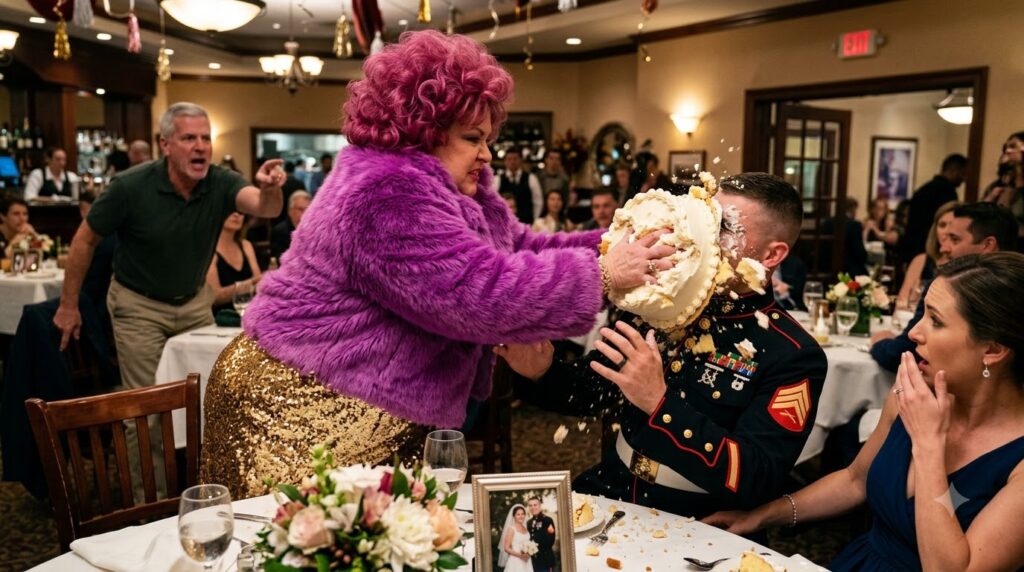
The Davidson County District Attorney’s Office reviewed the evidence concerning Karen’s attack on Ethan and Daniel’s punch.
The two acts were considered separately.
The video established that Karen had deliberately pressed the cake into Ethan’s face while he resisted.
It also established that she had shoved Daniel before he struck her.
The circumstances of Daniel’s response required closer consideration.
Investigators reviewed the distance between the two, Karen’s movement after the shove, and Daniel’s own statements.
Daniel acknowledged that anger had influenced his decision.
After consultation with counsel, he accepted responsibility through a negotiated misdemeanor resolution involving court-supervised conditions, including anger-management instruction and community service.
He did not receive a prison sentence.
But he did receive a consequence.
Daniel accepted it without complaint.
He had intervened because he believed someone needed help.
Yet he had learned that good intentions did not erase responsibility for his own actions.
Karen’s case followed a different path.
She was charged in connection with the assault on Ethan.
Faced with video evidence and witness testimony, she eventually entered a guilty plea to a misdemeanor assault charge under a negotiated agreement.
The court imposed probationary conditions, required her to complete an anger-management program, and ordered her to pay restitution for documented losses related to the attack.
The precise legal consequences were less dramatic than the internet had demanded.
There was no shouting courtroom confrontation.
No triumphant speech.
No moment when the judge humiliated Karen in front of an audience.
There was simply a formal process, evidence, legal representation, and accountability.
For Ethan, that was enough.
He attended the hearing with Sarah.
Karen arrived wearing a conservative black dress instead of her usual sequins.
Her fuchsia curls had been styled more modestly.
She avoided looking toward Ethan.
When the judge asked whether she understood the terms of her plea, she answered quietly.
For once, she did not dominate the room.
Sarah watched her carefully.
She had imagined feeling satisfaction when Karen was held accountable.
Instead, she felt tired.
The entire ordeal had consumed weeks of their lives.
They had spoken with police officers, attorneys, restaurant employees, and insurance representatives.
They had answered questions about a night they would rather forget.
And they had learned how easily a private celebration could become a public spectacle.
After the hearing, Jennifer explained that the civil matters still needed to be resolved.
Karen’s financial demands had lost much of their credibility, but formal claims could not simply be ignored.
Eventually, the parties reached a settlement addressing the documented property losses and related claims, without requiring Ethan to apologize or admit wrongdoing.
The terms remained private.
Karen also agreed not to contact Ethan and Sarah directly.
Thomas Bennett took separate action at the restaurant.
He permanently prohibited Karen from returning to the property.
He revised the restaurant’s procedures for handling threatening customers.
Employees were instructed to contact management and security immediately when a guest became abusive.
No employee would be expected to tolerate threats merely to avoid a complaint.
Rebecca introduced training sessions focused on de-escalation, documentation, and protecting guests.
Emily Foster attended the first session.
She remembered Margaret Ellis.
She remembered the day she had been told to apologize to the wrong person.
This time, she felt something different.
Relief.
Thomas also wrote Margaret a personal letter.
He acknowledged that the restaurant had failed to protect her experience.
He did not make excuses.
He offered to restore her favorite table for a private meal whenever she felt ready to return.
Margaret accepted.
She brought her daughter.
They sat beside the window and ordered the same breakfast Margaret and George had once shared.
For the first time in months, she felt comfortable there.
When Thomas stopped by to greet her, she thanked him.
Then she told him something he had not expected.
“People remember how you treat them when things go wrong.”
Thomas carried those words with him.
Because he knew the restaurant’s reputation had not been damaged merely by Karen’s behavior.
It had been damaged whenever good people were made to feel that their dignity mattered less than keeping a difficult customer satisfied.
And that was something he intended to change.