
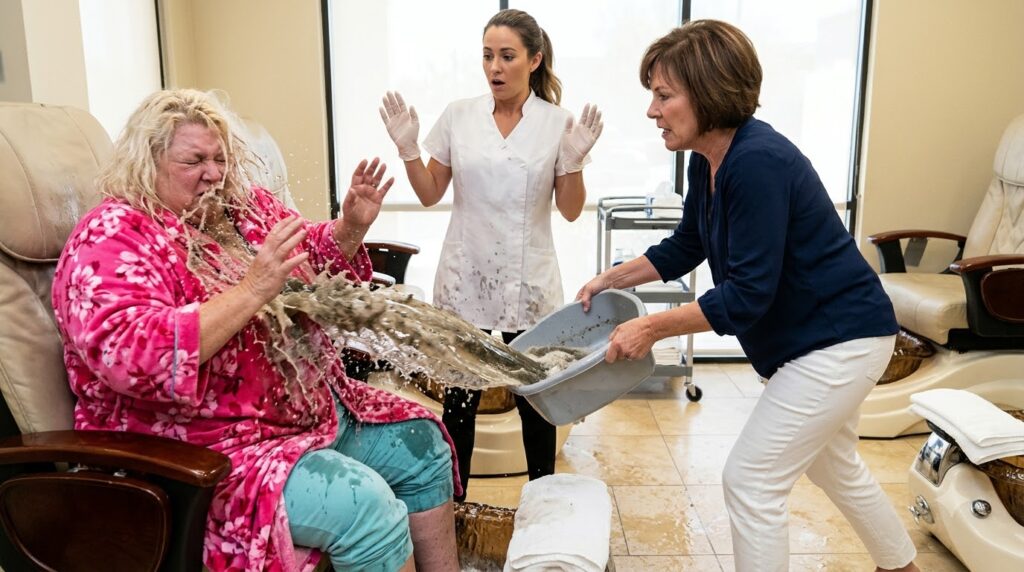
Chapter 4: A Complaint Nobody Wanted to Read
The following morning, Vanessa arrived at Serenity Springs carrying a folder.
Inside were her employment agreement, recent performance evaluations, the leave notification, and a written account of the incident.
She had also prepared a timeline.
Karen’s arrival.
The complaints about the water.
The demand that Vanessa kneel.
The deliberate splash.
Angela’s intervention.
The thrown water.
Karen’s attempt to seize the phone.
Vanessa had written everything down while her memory remained fresh.
She did not embellish.
She did not describe Karen as evil.
She did not speculate about motives she could not prove.
She focused on what had happened.
Melissa met her in a small office behind reception.
The manager looked exhausted.
Richard had called twice that morning.
Karen had threatened litigation and demanded compensation for emotional distress, damaged clothing, and what she called a deliberate public humiliation.
Vanessa placed her folder on the desk.
She explained that she wanted to file a formal workplace complaint.
Melissa accepted it.
Then Vanessa asked for a copy of the spa’s employee grievance procedure.
Melissa hesitated.
That hesitation told Vanessa more than any answer could have.
Serenity Springs had policies covering punctuality, uniforms, customer confidentiality, and service standards.
But its procedures for addressing abusive customers were vague.
Employees were instructed to remain courteous, notify management, and avoid confrontation.
There was little guidance about what happened when a customer became aggressive or physically abusive.
Vanessa had followed the first two instructions.
She had remained professional until Karen deliberately splashed her.
And even then, she had not retaliated.
Yet she was the one placed on unpaid leave.
Melissa admitted that the policy needed review.
Vanessa asked whether the company had ever suspended an employee after a customer assaulted them.
Melissa could not recall a comparable case.
That afternoon, Vanessa consulted an employment attorney named Daniel Reyes.
Daniel was fifty-eight and had spent more than twenty years representing employees and small businesses in Arizona.
He listened carefully.
He reviewed the video, the written complaint, and the leave notification.
He explained that rude customer behavior did not automatically establish a legal claim against an employer. Whether Vanessa had enforceable rights would depend on the facts, applicable laws, and the company’s actions.
He also warned her not to assume that the video alone would resolve everything.
The footage showed Karen’s behavior clearly.
But the company might argue that the leave was an administrative decision rather than punishment.
Daniel advised Vanessa to preserve every document, communicate professionally, and avoid public accusations while the matter was being evaluated.
He also suggested requesting written clarification about the reason for her leave and whether she would receive back pay if the investigation found no misconduct.
Vanessa followed his advice.
Her email to Richard was brief.
She described the incident, attached the recording, and requested a fair review.
She also asked that no employee be required to tolerate degrading treatment as a condition of employment.
Richard did not respond immediately.
Instead, he contacted Melissa.
He was unhappy that Vanessa had consulted an attorney.
He was even more unhappy that the video existed in multiple copies.
Melissa reminded him that preserving evidence was appropriate.
Richard changed the subject.
He wanted to know whether Angela could be persuaded to delete the recording.
Melissa refused to approach Angela with that request.
The refusal marked a turning point in their working relationship.
Richard had always appreciated Melissa’s ability to solve problems quietly.
Now she was insisting that the problem itself be addressed.
Meanwhile, Karen was preparing her own response.
She had visited a private medical clinic, where a physician examined her eyes and skin after the dirty-water exposure.
Fortunately, no serious injury was found.
Karen received instructions to monitor for irritation and seek further care if symptoms developed.
She nevertheless contacted an attorney and began assembling a claim against Angela and the spa.
She believed that the prospect of expensive litigation would force everyone to apologize.
What she did not anticipate was that another customer had witnessed the confrontation.
And that customer had something important to add.