
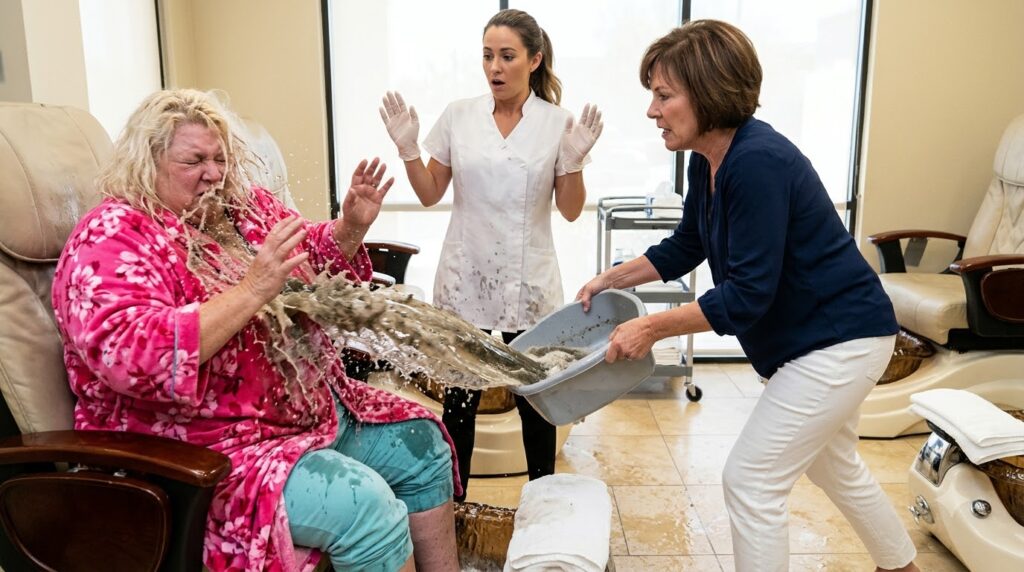
Chapter 8: A Different Kind of Luxury
Six weeks later, Serenity Springs looked much the same to its customers.
The cream-colored floors gleamed.
Fresh towels rested beside the treatment chairs.
Soft natural light filled the rooms.
But behind the polished appearance, significant changes had taken place.
Melissa had worked with Richard and an outside human-resources consultant to establish clearer procedures for dealing with abusive customers.
Employees were now explicitly authorized to pause or end a service when a customer threatened, degraded, or physically mistreated them.
Managers were required to document serious complaints and review repeated incidents rather than quietly reassigning employees.
Staff received training in de-escalation, safe intervention, and preserving evidence.
The spa also adopted a written code of conduct for customers.
It was displayed discreetly near reception and included in appointment confirmations.
The policy did not promise that every disagreement would disappear.
It established that respectful treatment was expected from everyone.
Vanessa helped review the new procedures.
She was not interested in becoming a symbol or a celebrity.
She wanted practical changes.
She suggested that employees have a clear way to summon a manager without leaving an aggressive customer unattended.
She recommended that staff be allowed to refuse unsafe tasks without fearing automatic discipline.
She also proposed a simple incident-reporting form that could be completed immediately after a confrontation.
Melissa accepted the recommendations.
Richard approved them.
The process was not effortless.
Some employees worried that enforcing boundaries would upset customers.
A few long-standing clients complained that the new code of conduct seemed unnecessary.
But most customers barely noticed.
They had never considered humiliating a worker in the first place.
And several employees began reporting that they felt more comfortable raising concerns.
Vanessa returned to her regular schedule.
Her first morning back had been difficult.
She had hesitated outside the pedicure room, remembering the sound of water striking her uniform.
For a moment, she had feared that every customer would remind her of Karen.
But her first appointment was with a retired librarian named Helen Parker.
Helen was seventy-four and had visited the spa monthly since moving to Scottsdale.
She greeted Vanessa warmly.
She asked about Emily.
She thanked Vanessa for helping her manage the discomfort in her feet.
The appointment passed peacefully.
At the end, Helen left a generous tip and a handwritten note.
The note said that kindness and professionalism should never be mistaken for weakness.
Vanessa kept it in her locker.
Over the following weeks, she gradually regained the confidence that the incident had shaken.
She continued working hard.
She continued treating customers with courtesy.
But she no longer believed that professionalism required enduring humiliation without objection.
Angela visited the spa again two months after the confrontation.
She had been uncertain whether returning would be appropriate.
Melissa assured her that she was welcome, provided everyone understood the expectation of nonviolent conduct.
Angela accepted that condition without hesitation.
She requested an appointment with Vanessa.
When they met, the atmosphere was initially awkward.
Angela remembered the water throw.
Vanessa remembered the consequences.
Neither pretended that the incident had been simple.
But they had developed a genuine respect for one another.
Angela had defended Vanessa when others remained silent.
She had also accepted responsibility for the harm her impulsive action could have caused.
Vanessa appreciated both.
During the appointment, Angela asked about Emily.
Vanessa smiled.
Her daughter had recently received an acceptance letter for a summer college-preparation program.
The news had brought joy back into their household after weeks of anxiety.
Angela was delighted.
She asked whether Emily had considered applying for scholarships.
Vanessa said they had begun researching them.
Angela offered to share resources from her years in education.
It was a small gesture.
No dramatic rescue.
No public announcement.
Just one woman offering practical help to another.
And that, Vanessa thought, was a better expression of solidarity than any basin of water could ever be.