
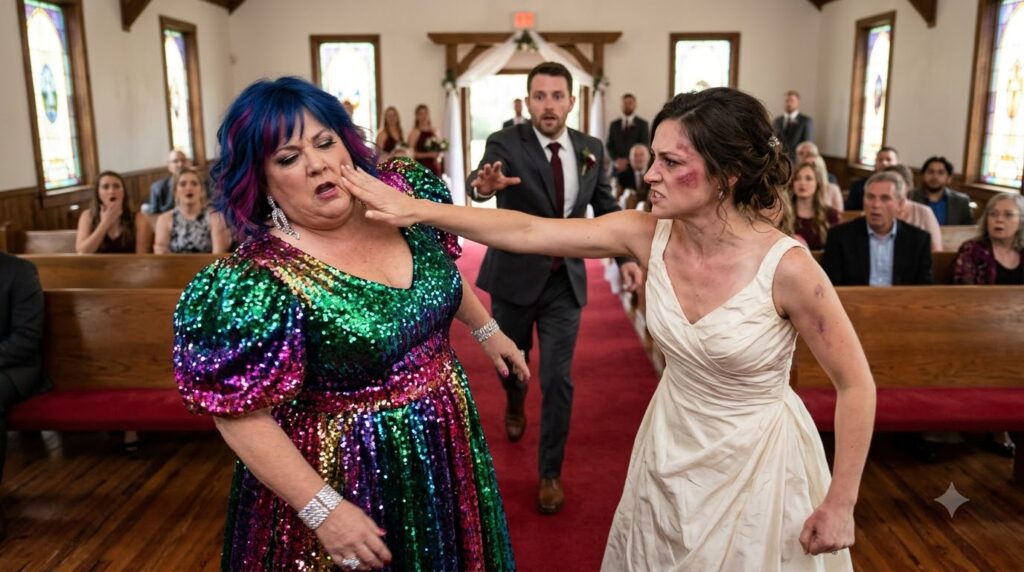
Chapter 2: The Woman Who Needed to Be First
To understand why Karen attacked me, you have to understand what happened after Daniel’s mother died.
Daniel was eleven when his biological mother, Rebecca, passed away following a long illness.
His father, Thomas Whitmore, married Karen three years later.
By Daniel’s account, Karen entered their home with impressive energy and an almost immediate determination to reorganize everything.
She changed the furniture.
She replaced family photographs.
She moved Rebecca’s belongings into boxes, claiming the house needed a fresh beginning.
Thomas, a quiet man who owned a successful heating and air-conditioning business, rarely challenged her.
He had lost his wife, was raising a grieving teenager, and wanted peace.
Karen understood that.
Over the years, she became the person who made every family decision.
She selected holiday menus, organized birthdays, and decided who deserved invitations to family gatherings.
If someone disagreed, Karen withdrew her affection until they apologized.
Daniel learned to avoid conflict by staying busy.
After college, he moved to Atlanta, built his career, and limited visits to major holidays.
But Karen never accepted that distance as independence.
She considered it a temporary inconvenience.
When Daniel introduced me at a family dinner, Karen examined me as though I were applying for a position.
I worked as an office manager for a regional medical practice. My parents were retired public school teachers. I owned a small townhouse and drove a seven-year-old Honda.
None of those facts impressed her.
During dessert, she asked whether I intended to stop working after marriage.
I told her I enjoyed my job.
She responded that Daniel needed a wife who understood the importance of family obligations.
I remember thinking it was an odd comment.
Later, I understood what she meant.
In Karen’s mind, family obligations meant obligations to Karen.
The first serious disagreement came when Daniel proposed.
He asked me to marry him beside Lake Lanier on a cool October evening. There was no audience, no photographer, and no elaborate performance.
Just Daniel, a simple diamond ring, and the promise that we would build a good life together.
I said yes before he finished asking.
Karen’s response was less enthusiastic.
She announced that the engagement party would take place at her house.
When Daniel explained that we’d already planned a small celebration with friends, she accused me of deliberately excluding her.
Over the following months, she tried to take control of our wedding.
She wanted a ballroom reception for two hundred guests.
We wanted a small chapel ceremony followed by dinner at a local restaurant.
She wanted a ten-tier wedding cake.
We wanted lemon cake from a neighborhood bakery.
She insisted that she should walk Daniel down the aisle because she’d raised him.
Daniel gently explained that he preferred to enter with his father.
Karen didn’t speak to him for eleven days.
Eventually, we settled on a chapel outside Gainesville, Georgia.
It had wooden pews, warm afternoon light, and a simple white arch decorated with flowers.
The entire ceremony would cost less than what Karen wanted to spend on table centerpieces.
We paid the deposit ourselves.
Or so I believed.
Three months before the wedding, Thomas offered to contribute toward the chapel and reception as a gift.
Daniel accepted after confirming there would be no conditions.
Karen later told us she’d handled the arrangements.
That should have worried me.
Instead, I was relieved.
By the week of the wedding, Karen had become increasingly difficult.
She demanded that the photographer reserve extra time for her portraits.
She asked the florist to change the arrangement colors to complement her gown.
She even suggested that Daniel and I should enter the reception separately so guests could properly acknowledge her.
Daniel refused.
Then, two nights before the ceremony, she called him.
I was sitting beside him when the conversation began.
I watched his expression change from patient to exhausted.
After fifteen minutes, he ended the call.
Karen had demanded that he make a speech thanking her for everything she’d sacrificed.
Not a general thank-you to our families.
A separate tribute.
Daniel told her he would thank both his parents, but the wedding would not become a ceremony honoring her.
She hung up.
The next morning, Karen sent me a photograph of her dress.
I stared at the image.
It was a rainbow-colored explosion of sequins, glitter, and enormous sleeves.
I replied that I hoped she would enjoy the celebration.
Her response came immediately.
Some women are born to stand out, Emily. Others should know when to step aside.
I showed Daniel.
He shook his head and apologized.
We agreed not to let her ruin our day.
What neither of us knew was that Karen had already begun contacting our wedding vendors.
And she had made arrangements that would put our entire celebration in jeopardy.