
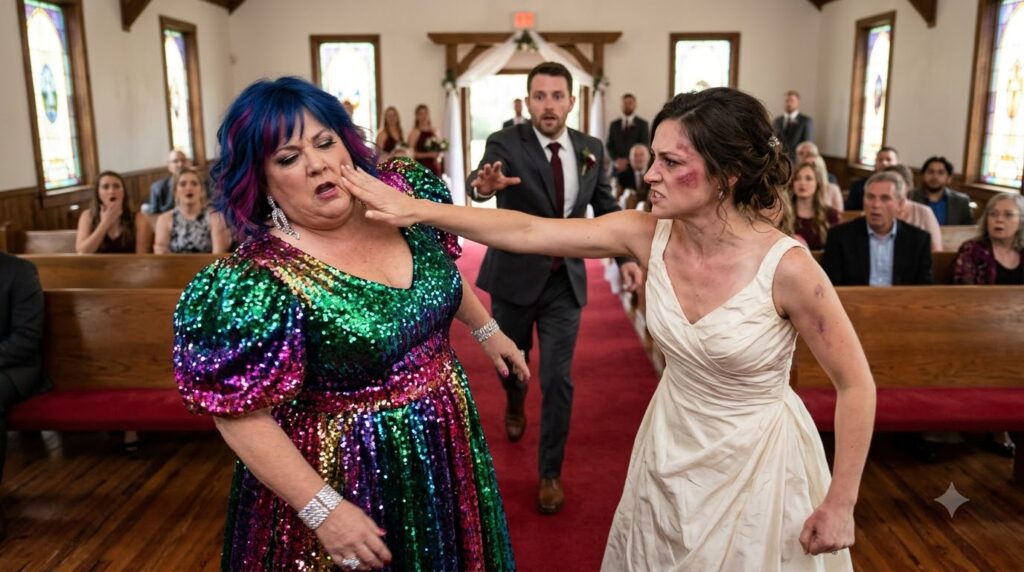
Chapter 8: The Family Finally Sees the Truth
Three weeks after the wedding, I received a call from Thomas.
He asked whether he could visit.
Daniel was at work, but I told Thomas he was welcome to come by that evening.
He arrived carrying a small cardboard box.
Inside were photographs of Daniel’s biological mother, Rebecca.
Some showed her holding Daniel as a baby.
Others captured birthday parties, school events, and ordinary family afternoons.
There was a photograph of Rebecca standing beside a Christmas tree, smiling with one hand resting on Daniel’s shoulder.
Thomas explained that he’d found the pictures while sorting through storage boxes.
Karen had packed them away years earlier.
He admitted that he should have objected.
He said he’d convinced himself that removing the photographs would help everyone move forward.
But looking at them now, he understood how much that decision had hurt his son.
Daniel sat quietly beside me.
He lifted one photograph from the box.
It showed Rebecca teaching him to ride a bicycle.
He remembered the afternoon immediately.
His mother had run behind him down their driveway, holding the back of the seat until he found his balance.
Daniel smiled.
Then his eyes filled.
Thomas apologized.
The two men sat together for a long time.
I went into the kitchen and made coffee, giving them privacy.
When I returned, Thomas was telling Daniel that he’d begun attending counseling.
He wanted to understand why he’d spent so many years avoiding confrontation.
He also wanted to decide what kind of marriage he was willing to remain in.
I was careful not to offer advice.
Thomas had to make his own decisions.
But I could see that he was beginning to recognize a pattern.
Karen had not simply been difficult.
She had used guilt, money, anger, and emotional pressure to control the people closest to her.
Her behavior had consequences far beyond our wedding.
A month later, the incident report and video were reviewed by local authorities.
The investigation focused on Karen’s initial assault and the immediate circumstances of my response.
After further review, Karen was charged with misdemeanor simple battery.
The legal process took several months.
Her attorney argued that the confrontation had been a mutual fight.
But the recording showed Karen striking me first, causing me to fall, and advancing toward me as I stood.
The witnesses supported that account.
My medical records documented the injury.
Ultimately, Karen accepted a negotiated resolution that included probation, a fine, and an anger-management requirement.
The court did not treat my retaliatory slap as a separate criminal offense.
I was relieved when the matter ended.
Not because the legal consequences erased what happened.
They didn’t.
But because Karen could no longer insist that the entire incident existed only in my imagination.
The official record reflected what we’d experienced.
Karen, however, remained unwilling to accept responsibility.
She told relatives that the court had misunderstood her.
She claimed the video had been taken out of context.
She accused Daniel of abandoning her.
At first, some family members believed her.
Then Rachel showed the original recording to relatives who had asked to see it.
She did not post it publicly.
She did not turn our wedding into an online spectacle.
She simply preserved the evidence and shared it where necessary to correct false claims.
That decision mattered to me.
I didn’t want strangers watching the worst moment of my wedding for entertainment.
I wanted the truth protected.
Eventually, the family gossip faded.
People who had previously defended Karen became quieter.
Several relatives contacted me privately to apologize for believing her accusations.
One cousin admitted that Karen had behaved similarly at other family events.
Another described years of feeling pressured to praise her and avoid upsetting her.
Their stories didn’t surprise me.
But they helped me understand that the wedding assault was not an isolated incident.
It was the moment when a long-standing pattern became impossible to ignore.
By early spring, Thomas had moved into a small rental house.
He and Karen were separated.
He told Daniel he didn’t know whether the marriage could be repaired.
But he knew he could no longer live under constant threats.
For the first time in decades, Thomas was making decisions without asking Karen’s permission.
And Daniel was beginning to know his father as a different man.