
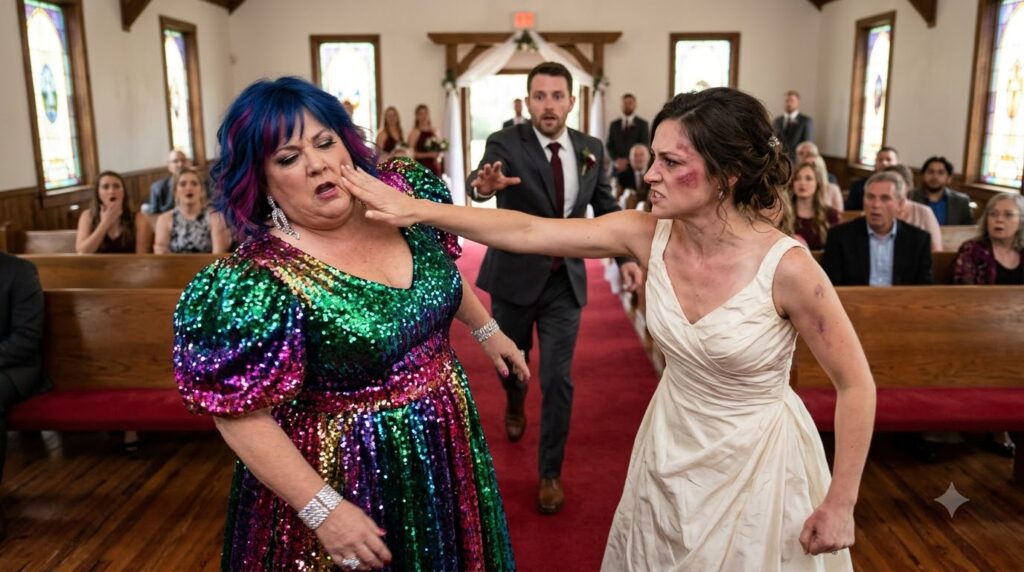
Chapter 7: The Price of Saying No
We did not go to Karen’s house.
That was Daniel’s decision.
He read her message, slipped his phone into his pocket, and told his father that he intended to spend the evening with his wife.
It was a simple sentence.
But for Daniel, it represented years of change compressed into a few words.
Karen had always relied on urgency.
A disagreement became an emergency.
A refused request became an insult.
A boundary became proof that someone didn’t love her.
She had trained everyone around her to respond immediately.
Daniel had spent most of his life doing exactly that.
Not anymore.
We went to the restaurant.
Linda Mercer met us at the entrance.
She took one look at my bruised face and quietly asked whether I needed anything.
I told her I needed a chair, a glass of water, and eventually a very large slice of lemon cake.
She smiled.
The private dining room was beautiful.
White tablecloths covered the tables.
Small arrangements of roses and greenery stood beside candleholders.
Our wedding photographs from the engagement session were displayed near the entrance.
The seating plan was exactly as we’d approved it.
Daniel and I sat together.
Our parents sat nearby.
Karen’s chair remained empty.
At first, I kept looking toward the door.
I expected her to appear at any moment, demanding attention and insisting that everyone had misunderstood her.
But she never came.
Dinner began.
My father gave a short toast.
He spoke about how marriage was not measured by perfect celebrations, but by the way two people treated each other when life became difficult.
His voice shook slightly.
I knew he was thinking about what he’d witnessed.
Daniel squeezed my hand beneath the table.
Later, Thomas stood.
He hadn’t planned to make a speech.
He looked older than he had that morning.
He told the room that he’d spent too many years avoiding difficult truths.
He acknowledged that the day’s events should never have happened.
Then he apologized to me.
Not on Karen’s behalf.
For his own failure to recognize how badly things had deteriorated.
I appreciated the distinction.
Thomas couldn’t apologize for another adult’s actions.
But he could take responsibility for his silence.
After dinner, Daniel and I cut the lemon cake.
Someone played our favorite song.
We danced slowly in a small open space between the tables.
My face hurt.
My feet ached.
My dress was wrinkled.
It was not the wedding I’d imagined.
But when Daniel held me, I felt more certain of our marriage than I had that morning.
The following week brought consequences.
Karen sent Daniel a series of messages accusing him of betrayal.
She demanded that he apologize for allowing me to strike her.
She insisted that Rachel delete the video.
She told Thomas that he needed to choose between his wife and his son.
Then she threatened to remove Daniel from her estate plans.
Daniel responded only once.
He told her that he would not discuss reconciliation until she acknowledged the assault, stopped spreading false accusations, and respected our boundaries.
He also asked her not to contact me.
Karen ignored the request.
She began sending messages to my work email.
Some were insulting.
Others were written as though nothing had happened.
One message suggested that we should put the incident behind us before Thanksgiving.
Another accused me of deliberately turning Daniel against his family.
I saved everything.
At Rachel’s suggestion, I organized the messages, emails, medical records, and witness information in a folder.
I wasn’t interested in revenge.
But I had learned that keeping records mattered when someone repeatedly tried to rewrite events.
Meanwhile, Thomas began examining the wedding expenses.
What he discovered was worse than he’d expected.
Karen had spent more than eight thousand dollars on her personal wedding appearance and related arrangements.
She’d charged the expenses to their joint account while describing them as family celebration costs.
Thomas had approved a contribution toward our reception.
He had not agreed to finance Karen’s private spectacle.
The disagreement over the money became the first serious financial confrontation of their marriage.
For years, Thomas had handed over responsibility for household spending because it was easier than arguing.
Now he began reviewing statements.
He found other unexplained purchases.
Not necessarily illegal.
But hidden, excessive, and inconsistent with what Karen had told him.
He contacted a financial adviser.
He also made an appointment with an attorney.
When Karen learned about the appointments, she became furious.
And for the first time, her anger was directed at someone who had always given in.
Her husband.