Chapter 2: The Agreement Nobody Could Ignore
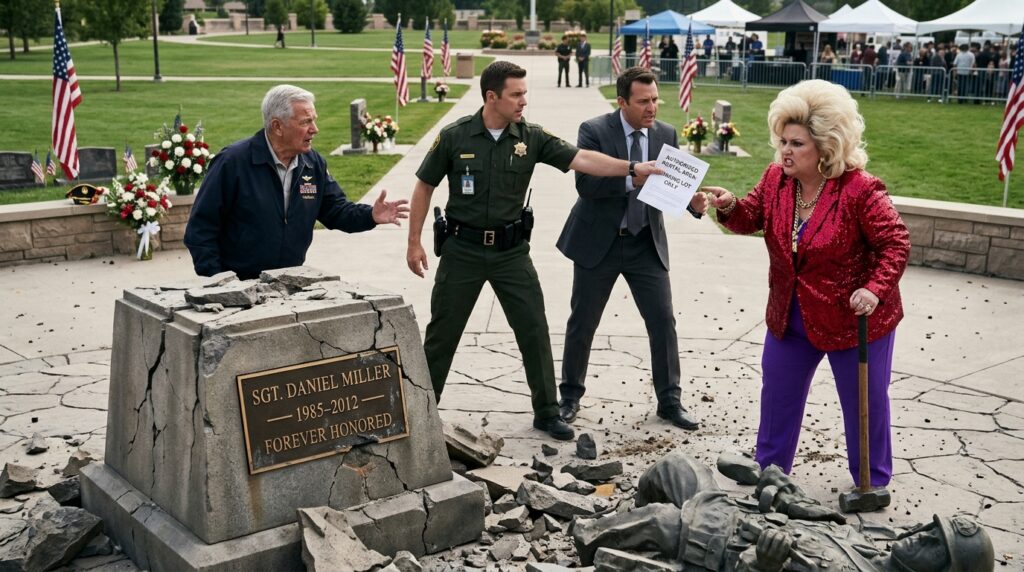
Ranger Reed secured the sledgehammer before Karen could reach it again.
He placed it beyond her reach, instructed the workers to remain clear of the debris, and radioed for law enforcement.
Karen immediately demanded his supervisor.
She claimed that he had embarrassed her in front of employees and interfered with a legally authorized business event.
Reed listened without arguing.
Then he pointed toward the shattered statue.
“That monument is public memorial property. Your event agreement doesn’t give you authority to touch it.”
Karen folded her arms.
Her gold jewelry flashed in the sunlight.
She insisted that the statue had been an obstruction, that its pedestal was already deteriorating, and that the memorial park should have appreciated her willingness to improve the area.
Michael Bennett stood several feet away, still holding the contract.
He had worked in event management for more than twenty years. He had handled corporate retreats, charity galas, weddings, and political fundraisers.
He had never seen a client destroy a public monument.
And he had certainly never expected to witness it while holding a document explicitly forbidding interference with park property.
The event, called the Rocky Mountain Prestige Leadership Gala, was scheduled for the following afternoon.
Karen had advertised it as an exclusive gathering for business owners, investors, and prominent community figures.
Guests had paid substantial registration fees.
Several companies had purchased sponsorship packages.
A luxury automobile dealership had arranged to display vehicles near the event entrance.
Karen had rented the parking lot beside the memorial park to accommodate the gathering.
Nothing more.
Michael had explained the boundaries during a planning meeting two weeks earlier.
He remembered the conversation clearly because Karen had complained about the memorial interfering with her preferred layout.
She wanted the statue removed so the event’s red-carpet entrance could extend across the plaza.
Michael had told her the monument was outside the rental area.
He had also explained that removing it would require authorization from the public authority responsible for the park.
Karen had dismissed the issue.
Now Michael realized she had never accepted the answer.
Two sheriff’s deputies arrived within minutes.
They separated the witnesses and began collecting statements.
Karen tried to present herself as the victim of a misunderstanding.
She said the monument had been unsafe.
She said the pedestal was crumbling.
She said she had been protecting guests from a potential accident.
But the workers told a different story.
One of them, a 32-year-old setup supervisor named Luis Ortega, explained that Karen had ordered the crew to bring demolition tools that morning.
When Luis refused to use them on the statue, she had taken the sledgehammer herself.
He had warned her that the monument was protected.
She had ignored him.
Luis showed the deputies a video he had recorded.
The footage began before the first blow.
Karen could be heard telling the crew that the memorial was ruining the appearance of her VIP entrance.
Then she picked up the hammer.
The recording showed the strikes, the collapse, and her confrontation with Robert.
It also captured her threat to destroy the rest of the memorial.
The deputies watched silently.
Karen’s explanation began to fall apart.
Meanwhile, Robert sat on a stone bench near the flagpoles.
A paramedic checked his blood pressure after noticing his trembling hands and pale complexion.
Robert insisted that he did not need an ambulance.
He wanted to remain with Daniel.
Ranger Reed approached and sat beside him.
“I knew your brother,” Reed said quietly.
Robert looked up.
Reed explained that he had been a young park employee when the memorial was dedicated.
He remembered the ceremony, the folded flags, the families, and the schoolchildren who had lined the walkway.
He remembered Robert standing beside the statue, holding his brother’s photograph.
Robert lowered his eyes.
“Daniel would’ve hated all this attention,” he murmured.
Reed nodded.
“Maybe. But he deserved the honor.”
For several moments, neither man spoke.
Across the plaza, deputies photographed the wreckage.
The statue’s broken head had been carefully marked as evidence. Its separated arm lay near the base of the pedestal.
The remaining fragments were scattered over an area that had once been filled with flowers.
Robert looked toward the damaged inscription.
“I helped pay for that statue,” he said.
Reed turned toward him.
Robert explained that after Daniel’s death, he had contributed a significant portion of his savings to the memorial fund.
Daniel’s fellow soldiers had donated.
Local veterans had organized fundraisers.
Schoolchildren had collected coins.
A retired sculptor had reduced his fee because he believed the project mattered.
It had never been an expensive monument by national standards.
But to the people who built it, it was priceless.
Reed listened carefully.
Then he told Robert something important.
The park maintained records of the monument’s dedication, ownership, and preservation requirements.
Those records would help establish exactly what Karen had damaged.
Robert nodded.
For the first time since arriving, he felt something other than helplessness.
The statue was broken.
But the truth had not disappeared with it.
As deputies prepared to take Karen into custody for questioning and potential charges, Michael approached Robert.
He looked deeply uncomfortable.
“Mr. Miller, I need to tell you something.”
Robert raised his head.
Michael glanced toward Karen.
“She asked me about removing that statue three weeks ago.”
Robert’s expression changed.
“Removing it?”
Michael swallowed.
“She wanted to know whether anyone would notice if it was gone before the event.”
Robert stared at him.
The destruction had not been a sudden outburst.
Karen had been thinking about his brother’s memorial for weeks.
And Michael had kept the emails.