Chapter 4: A Price on a Soldier’s Memory
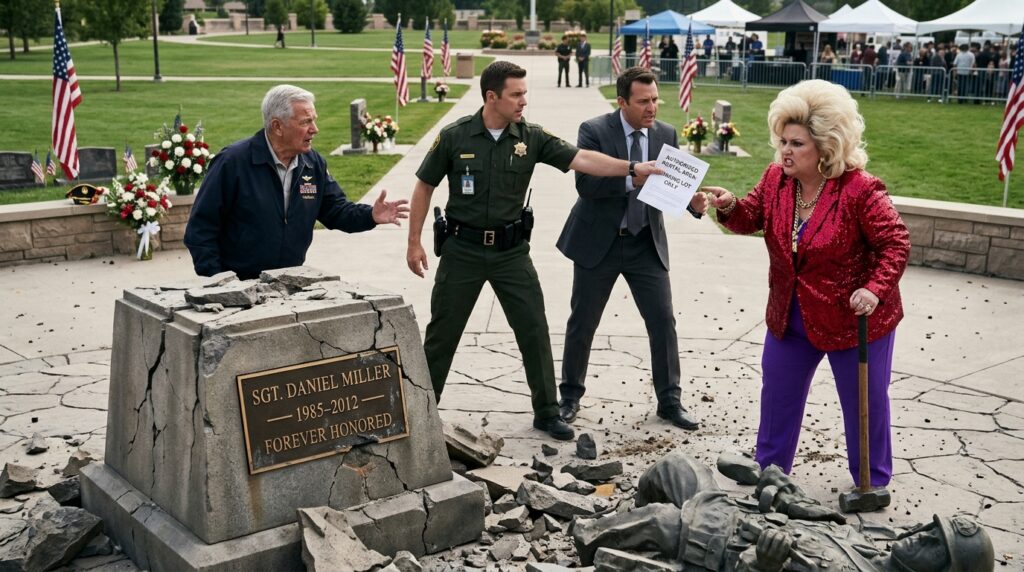
The first restoration estimate arrived four days after the statue was destroyed.
Robert opened the envelope at his kitchen table.
Emily sat beside him.
The assessment had been prepared by a professional stone conservation firm hired to inspect the damage.
The pedestal had fractured beyond safe repair.
The statue’s torso had broken into several major sections.
Its head could potentially be restored as a separate artifact, but the full monument could not simply be glued together and returned to its original location.
The estimated cost of a historically faithful replacement, including structural engineering, sculpting, installation, and site repairs, was $186,000.
Robert read the figure three times.
Emily leaned over his shoulder.
“That’s more than the original statue cost.”
Robert nodded.
Construction materials, specialized labor, and preservation requirements had become considerably more expensive since the dedication.
The park authority also wanted a stronger foundation to prevent future structural problems.
Robert understood the reasoning.
But the number frightened him.
He had enough savings to live modestly.
He did not have nearly two hundred thousand dollars.
Nor did he believe Daniel would have wanted him to sacrifice his retirement security for a monument.
A community fundraising campaign began almost immediately.
Local veterans donated.
Businesses offered support.
A school organized a charity walk.
Within the first week, the fund collected more than $34,000.
It was an encouraging start.
Then Karen’s attorney entered the picture.
His name was Richard Collins, a polished civil litigator from Denver.
He contacted the park authority with a proposal.
Karen would consider contributing $25,000 toward restoration if the authority agreed to a broad civil settlement and issued a public statement describing the incident as a dispute over an unsafe structure.
The proposal did not resolve the criminal investigation, and the authority could not promise to control prosecutors.
But the requested language alarmed Robert.
An unsafe structure.
A dispute.
As though Karen had accidentally damaged a retaining wall.
As though Daniel’s memorial had been an inconvenience rather than a protected place of remembrance.
The park authority rejected the proposed wording.
Karen’s attorney then argued that the existing cracks in the pedestal had contributed to the collapse.
He requested maintenance records and suggested that the park’s failure to repair the base might have made the destruction more severe.
Robert knew the pedestal had been weathered.
He had noticed the cracks himself.
But he also knew the statue had stood until Karen struck it repeatedly with a sledgehammer.
The argument felt like another insult.
Yet the legal questions were not entirely simple.
Investigators needed to distinguish preexisting deterioration from damage caused by Karen’s actions.
The restoration claim required reliable estimates.
The park authority had to document ownership and preservation responsibilities.
And because Karen’s event company had rented the adjacent lot, its insurance arrangements were being examined.
The case could take months.
Possibly longer.
Robert began losing sleep.
He worried that the memorial would remain broken while attorneys argued over paperwork.
He worried that public attention would fade.
Most of all, he worried that Emily would remember her father’s monument as a pile of rubble surrounded by caution tape.
One afternoon, Ranger Reed visited Robert with an unexpected piece of information.
During the site assessment, workers had discovered a small sealed metal container inside a cavity beneath the pedestal’s commemorative plaque.
It appeared to have been placed there during the original dedication.
The container was intact.
Reed explained that the park authority wanted Robert and Daniel’s family present when it was opened.
Robert remembered hearing something about a dedication capsule years earlier, but grief had blurred much of that day.
He agreed to attend.
The following morning, Robert and Emily met Reed at the park office.
Michael Bennett was not present.
Neither was Karen.
The container was placed on a table and carefully opened.
Inside were photographs, handwritten notes, a copy of the dedication program, and a folded letter sealed in a clear protective sleeve.
The letter was addressed to Daniel’s daughter.
Emily looked at Robert.
He recognized the handwriting immediately.
It belonged to Daniel’s commanding officer, Captain James Holloway.
Holloway had written the letter after Daniel’s death, intending it to be preserved for Emily until she was old enough to understand the significance of her father’s service.
Robert had never known the letter existed.
Emily carefully unfolded the paper.
The room fell silent.
The letter described Daniel’s courage, his concern for younger soldiers, and his habit of checking on anyone who seemed lonely or frightened.
It also described the circumstances surrounding his final mission.
Daniel had helped evacuate wounded personnel during an attack.
He had returned to assist another soldier when the situation became dangerous.
He never made it back.
Emily read the letter without speaking.
Tears gathered in her eyes.
Then she reached the final paragraph.
Captain Holloway had written that Daniel’s greatest pride was not his military rank or his awards.
It was his daughter.
He had spoken about Emily constantly.
He had carried her photograph in his uniform pocket.
And he had once told Holloway that whatever happened to him, he hoped she would grow up knowing she had been loved.
Emily covered her mouth.
Robert placed an arm around her shoulders.
For the first time since the statue fell, they were not thinking about Karen.
They were thinking about Daniel.
And the letter gave them something no replacement statue could provide.
A piece of his life that had been waiting fourteen years to be discovered.