Chapter 3: The Messages Behind the Smiles
By the following morning, the video had spread throughout Colorado.
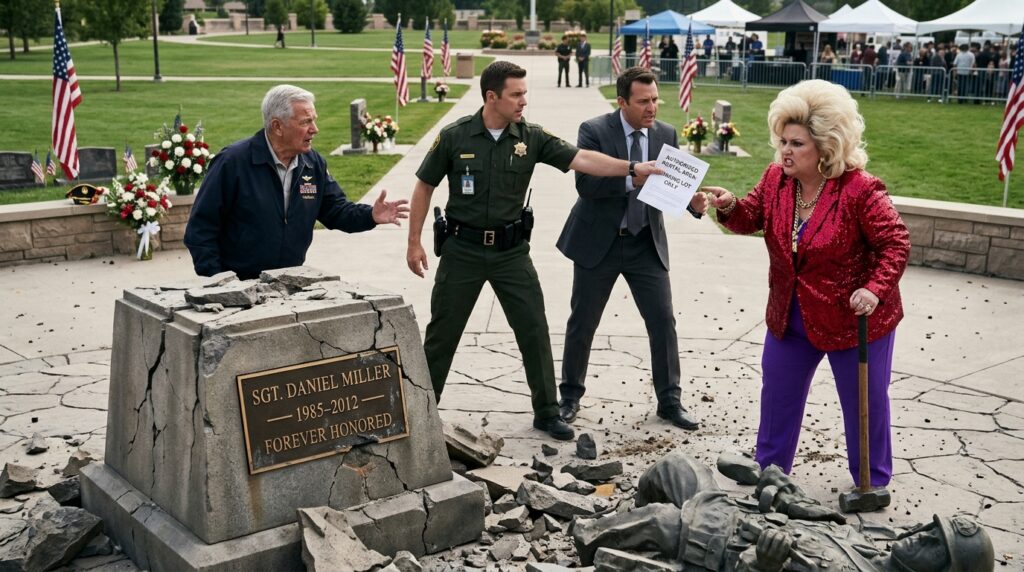
Local television stations showed the statue collapsing.
Newspapers published photographs of Robert standing beside the wreckage.
Veterans’ organizations issued statements condemning the destruction.
But the strongest public reaction came from ordinary residents.
People who had walked past the memorial for years began sharing their memories.
A retired teacher remembered bringing her fifth-grade class to the dedication ceremony.
A former Army medic recalled serving with Daniel overseas.
A woman from a neighboring town wrote that her husband’s name appeared on a nearby commemorative plaque.
For many people, the memorial had never been merely decorative.
It was a place where grief could exist without explanation.
Robert did not watch the coverage.
He spent the morning at home, sitting at his kitchen table with Daniel’s old letters spread before him.
His house was modest, with a narrow front porch, faded family photographs, and a backyard where Daniel had once helped him build a wooden shed.
Robert’s wife, Margaret, had died six years earlier.
Since then, the house had grown quieter.
Daniel’s memorial had become one of the few places where Robert felt connected to both his brother and the years when their family had still been whole.
Now even that refuge had been violated.
His niece, Emily Miller, arrived shortly after ten.
Emily was Daniel’s daughter.
She had been only three years old when her father died.
Now seventeen, she was finishing high school and preparing to apply to college.
She carried a paper bag containing breakfast sandwiches, but neither of them felt hungry.
Emily had seen the video.
She had watched the statue fall.
She had also watched Karen throw flowers onto the broken stone.
For a long time, Emily stood beside the kitchen window.
Then she asked a question that Robert could not answer.
“Why would someone hate a person they never even knew?”
Robert looked down at Daniel’s letters.
“I don’t think she hated him,” he said. “I think she didn’t care who he was.”
That answer seemed to hurt Emily even more.
Later that afternoon, Michael Bennett visited the house.
He had called ahead and asked whether Robert would be willing to speak with him.
Robert almost refused.
But Emily encouraged him to listen.
Michael arrived carrying a laptop and a folder of printed emails.
He explained that Karen had begun pressuring him to alter the event layout several weeks earlier.
At first, her requests seemed ordinary.
She wanted more room for photographers.
She wanted a wider entrance.
She wanted the sponsor displays positioned where arriving guests would see them immediately.
Then the messages became more specific.
Karen asked whether the memorial statue could be moved temporarily.
Michael replied that it was outside the rented property and could not be relocated without authorization.
Karen suggested covering it with decorative panels.
Michael explained that the panels would obstruct the memorial walkway.
She then proposed building a temporary platform around the pedestal.
Again, Michael refused.
Finally, one message contained a sentence that made Robert’s hands turn cold.
“That ugly soldier statue is standing between me and a perfect event. Find a way to make it disappear.”
The message was dated eleven days before the destruction.
Michael had answered that he would not authorize any action involving the monument.
He had believed the matter was settled.
But three days later, Karen sent another message.
This one was shorter.
“If nobody else has the courage to fix the problem, I will.”
Robert read it twice.
Then he pushed the paper away.
Emily leaned forward.
“Did you give these to the police?”
Michael nodded.
He had already provided the complete email chain to investigators.
He also intended to cooperate with the park authority and any civil proceedings.
Robert studied him.
“Why didn’t you warn somebody?”
The question landed heavily.
Michael did not immediately answer.
He admitted that he had treated Karen’s messages as aggressive business complaints rather than serious threats.
He had worked with demanding clients before.
He had assumed she would eventually accept the restrictions.
“I should’ve taken her words more seriously,” he said.
Robert could see the regret in his face.
But regret did not rebuild stone.
Michael left after promising to provide any further information investigators requested.
That evening, Emily helped Robert organize Daniel’s photographs.
They found one taken during his final visit home.
Daniel stood in Robert’s backyard, laughing while holding a crooked birdhouse he had built with Emily.
In the photograph, Emily was a toddler sitting on her father’s shoulders.
Robert remembered the day.
Daniel had spent the afternoon repairing a fence and teasing Robert about his terrible cooking.
Nobody had known how little time remained.
Emily held the photograph for a long while.
Then she placed it beside the printed emails.
“Grandpa Robert,” she said, “I don’t want people to remember Dad because of that woman.”
Robert looked at her.
“Neither do I.”
Emily straightened.
“Then we need to tell them who he really was.”
Robert felt a quiet determination begin to replace his grief.
Karen had made the destruction famous.
But perhaps Daniel’s family could make his life impossible to overlook.
The next morning, they would discover that the fight to restore the memorial was already becoming more complicated than either of them expected.