Chapter 7: The Day the Truth Went on Record
Six months after the destruction, Karen Whitmore entered a Colorado courtroom wearing a conservative black suit.
Her platinum-blonde hair was styled more modestly than usual.
The oversized sunglasses were gone.
So were the sparkling red blazer and metallic gold shoes.
But her expression remained rigid.
She had been charged in connection with the destruction of the memorial, including an allegation of intentional criminal damage to property.
The precise legal consequences would depend on the evidence, the applicable statutes, and the court’s findings.
Karen had pleaded not guilty.
Her defense emphasized the pedestal’s deteriorated condition and argued that she had misunderstood the scope of her authority.
The prosecution presented a different account.
Michael Bennett testified about the rental agreement.
He identified Karen’s signature and explained the boundaries of the authorized parking area.
The contract was admitted into evidence.
Its language was clear.
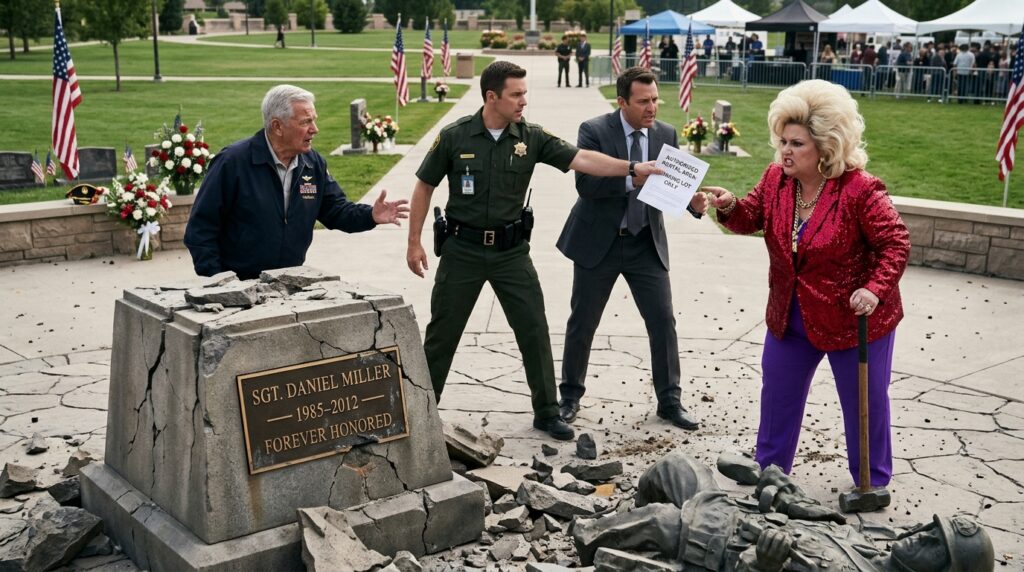
AUTHORIZED RENTAL AREA: PARKING LOT ONLY.
Michael also identified the emails he had exchanged with Karen before the incident.
He acknowledged that he had underestimated the seriousness of her threats.
But he confirmed that he had never given permission to remove or damage the statue.
Luis Ortega testified next.
He described Karen’s orders on the day of the destruction.
He explained that he had refused to participate.
Then prosecutors played his video.
The courtroom watched Karen lift the sledgehammer.
The first blow struck the pedestal.
The second widened the fracture.
The statue tilted.
Then it fell.
The sound of breaking stone filled the courtroom speakers.
Robert closed his eyes.
He had avoided watching the full video since the day it happened.
Now he heard the crash again.
He felt Emily’s hand close around his.
The recording continued.
Karen threw the flowers.
She shouted at Robert.
She claimed the event space belonged to her.
Then came Michael’s confrontation with the rental agreement.
And finally, Karen’s threat.
“THEN I’LL DESTROY THE REST!”
The room remained silent when the video ended.
A structural engineer testified that the pedestal had indeed suffered weathering and preexisting cracks.
Those conditions had made it more vulnerable to impact.
But the engineer also explained that the statue had remained standing before Karen struck the base.
The hammer blows caused the fractures that destabilized it.
The existing deterioration did not authorize its destruction or make the collapse accidental.
The defense challenged the conclusions and questioned whether a falling statue could have caused greater harm if left unrepaired.
The engineer acknowledged that maintenance had been appropriate.
He did not retreat from his finding that the deliberate impacts caused the collapse.
Robert was called to testify about the memorial’s history.
He described the community fundraising campaign.
He explained Daniel’s service and the significance of the monument.
He told the court how he had arrived carrying carnations and found his brother’s statue destroyed.
He did not raise his voice.
He did not insult Karen.
He simply described what happened.
When asked how the incident affected him, Robert paused.
Then he said that the memorial had been one of the last places where he could visit his brother in peace.
Karen’s actions had taken that peace away.
The trial continued over several days.
The jury reviewed the video, the rental agreement, the emails, witness testimony, and the engineering evidence.
When deliberations ended, the jurors returned guilty verdicts on the principal criminal-damage charge and a related offense arising from Karen’s conduct at the memorial.
Karen stared straight ahead as the verdicts were read.
Robert did not celebrate.
He felt relief, but it was quieter than he had expected.
A verdict could establish responsibility.
It could not restore the afternoon before the hammer fell.
Sentencing was scheduled for a later date.
The civil claim for restoration costs remained separate.
Outside the courthouse, reporters gathered around Robert.
They asked whether he was satisfied.
He considered the question.
Then he answered.
“I’m glad the truth was heard. Now I want my brother’s memorial back.”
Emily stood beside him.
Andrew Collins had traveled to attend the final day of trial.
Ranger Reed was there too.
For the first time in months, Robert looked around and realized how many people had joined the effort.
He had arrived at the memorial alone on the day of the destruction.
He was no longer alone.
And the work of rebuilding was finally ready to begin.