
Chapter 3: The Officer on the Floor
Officer Daniel Mercer had been working at West Briar for nine years.
He had joined the correctional service after leaving the Army, drawn by stable employment, health benefits, and the opportunity to remain close to his family.
He lived in a small house outside Weatherford with his wife, Lauren, and their eleven-year-old son, Caleb.
Mercer was not known for losing his temper.
His supervisors described him as dependable, especially during difficult inmate movements. He followed procedures, kept detailed records, and rarely raised his voice unless safety required it.
On the morning Karen charged the gate, Mercer was supervising a routine transfer of staff between two secured sections.
The gate was not malfunctioning.
It had been opened through the authorized control system.
Karen had been in the corridor for an approved escorted movement and was supposed to remain beside the designated waiting line.
Instead, she had watched the gate begin to move and acted without warning.
The collision left Mercer with a badly bruised shoulder, a sprained wrist, and pain along his ribs.
Medical imaging found no fractures.
Still, he could not immediately return to full duty.
He was placed on temporary medical leave while the facility reviewed the incident.
The physical injuries frustrated him, but something else troubled him more.
He kept remembering Karen’s face just before she struck him.
There had been no confusion in her expression.
No accidental stumble.
She had looked directly at him and continued forward.
That evening, Mercer sat at his kitchen table with an ice pack against his shoulder.
Caleb noticed the swelling beneath his father’s shirt.
“Did somebody hurt you at work?”
Mercer considered offering a vague answer.
Instead, he explained that an inmate had tried to get through a secured gate and had knocked him down.
Caleb looked frightened.
“Are you going back?”
Mercer rested his good hand on the boy’s shoulder.
“Yes. But not until the doctor says I can.”
Lauren listened from the kitchen.
She knew her husband believed in treating incarcerated people with dignity. She also knew he sometimes minimized the dangers of his job because he did not want his family worrying.
That night, after Caleb went to bed, she asked him whether the incident had been avoidable.
Mercer thought carefully.
He had followed the movement procedure as written. Karen had been under supervision, and the gate was being opened for legitimate operational reasons.
But he also recognized that procedures could be improved.
The waiting position had been too close to the gate’s approach.
There had been no physical barrier between Karen and the officer during the opening sequence.
And the corridor’s layout allowed a sudden charge to develop before another officer could intervene.
Mercer included those observations in his report.
He did not exaggerate his injuries or describe Karen in insulting terms.
He recorded what happened, what he saw, and what he believed could reduce the chance of another incident.
Meanwhile, the facility’s security investigators began reviewing six camera feeds.
The footage confirmed the sequence.
Karen stepped backward.
She accelerated toward the gate.
Mercer attempted to stop her.
She struck him and continued into the second corridor.
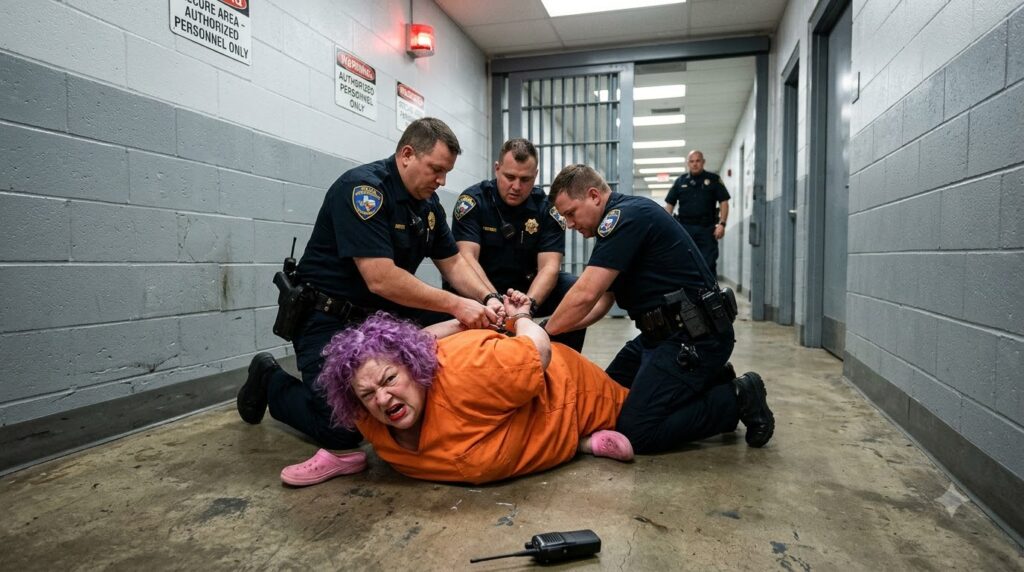
Three responding officers intercepted her before she reached the next checkpoint.
Investigators also reviewed the responding officers’ use of force.
They examined whether the restraint had been necessary, whether the officers had stopped applying force once Karen was controlled, and whether she had received appropriate medical attention afterward.
Karen had complained of pain in her shoulder and knees.
Medical staff examined her and documented bruising without evidence of serious injury.
The investigation would not treat her complaints as irrelevant simply because she had initiated the confrontation.
That was important to Warden Patricia Holloway.
Holloway had spent twenty-seven years working in corrections. She believed that discipline required consistency, not humiliation.
An inmate who assaulted an officer had to be held accountable.
An officer who used unnecessary force would also have to answer for it.
The rules applied in both directions.
But when Holloway reviewed the surveillance footage, one detail caught her attention.
After Karen knocked Mercer down, she briefly turned her head toward the camera and smiled.
The expression lasted less than a second.
It was enough to suggest that Karen believed she had accomplished something worth celebrating.
Holloway replayed the footage once.
Then she closed the file.
The incident would be referred for possible additional criminal charges, and Karen would face an institutional disciplinary hearing.
But the warden suspected that punishment alone would not address the deeper problem.
Karen had spent years confusing control with respect.
And prison had not changed that belief.