
Chapter 5: The Hearing Karen Couldn’t Control
The institutional disciplinary hearing took place twelve days after the incident.
Karen entered the hearing room wearing a clean orange jumpsuit. Her purple curls had been carefully arranged, and her expression suggested she expected to be treated as an important guest rather than an inmate facing serious allegations.
A correctional officer escorted her to a chair.
Across the table sat a designated hearing officer, an administrative representative, and a staff member responsible for recording the proceedings.
Karen had received written notice of the alleged violations and an explanation of the hearing process.
She was permitted to present her account, identify relevant evidence, and request available assistance under facility procedures.
She had prepared six pages of handwritten notes.
Her central argument was simple.
The gate had opened.
She had walked through it.
The officers had overreacted.
The hearing officer asked whether she had been authorized to enter the second corridor.
Karen said she should not have needed authorization because she had been treated unfairly for months.
That did not answer the question.
She was asked again.
This time, Karen insisted she had been confused.
The surveillance footage contradicted that explanation.
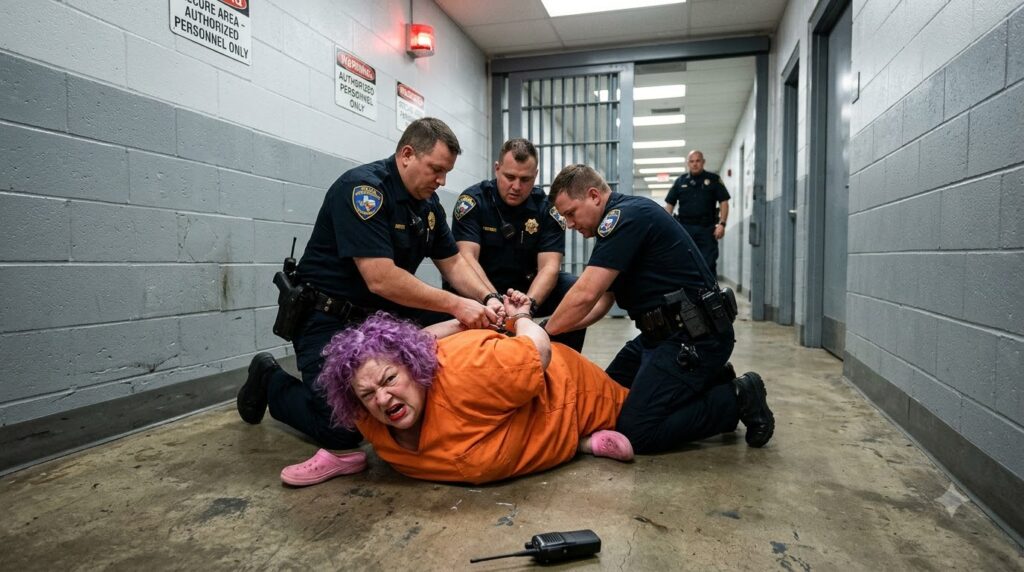
The recording showed her stepping backward to gain momentum before charging toward Mercer.
It showed the collision.
It showed her continuing down the second corridor after Mercer fell.
Karen objected to the footage being played.
She claimed the camera angle made her appear more aggressive than she had been.
The hearing officer allowed her objection to be recorded and continued reviewing the evidence.
Then came the statements from Officers Bell, Ruiz, and Briggs.
Their accounts were consistent on the central facts.
Karen had ignored repeated commands, attempted to force her way through a secured checkpoint, and resisted restraint.
The medical records documented her examination after the incident.
Mercer’s injury report documented the consequences of the collision.
Karen had expected a confrontation she could dominate with volume and indignation.
Instead, she encountered a process that continued whether she shouted or remained silent.
She demanded to speak to the warden.
The hearing officer explained that the disciplinary process had its own procedures and that Karen could pursue available review channels afterward.
Karen accused everyone in the room of conspiring against her.
The hearing officer paused the proceeding until she could continue without interrupting.
When it resumed, Karen was given another opportunity to explain her actions.
She said she had been desperate.
She said she missed her home.
She said prison had made her feel powerless.
For the first time, her words sounded less like an accusation and more like an admission of fear.
But she quickly returned to blaming Mercer for standing in her way.
The hearing officer considered the evidence and found that Karen had committed serious institutional violations, including assaultive conduct, unauthorized movement into a secured area, and refusal to obey lawful commands.
The sanctions included a loss of certain privileges, a change in custody classification, and a period of restricted housing subject to facility review.
The incident was also referred to prosecutors for consideration of new criminal charges.
Karen’s existing sentence did not automatically increase because of the disciplinary finding. Any additional criminal punishment would require a separate legal process.
She did not appreciate the distinction.
She heard only that she might spend more time incarcerated.
Her face reddened.
She threatened lawsuits against the prison, the hearing officer, and every correctional employee involved.
No one argued with her.
The hearing concluded.
As Karen was escorted back to her housing area, she passed a window overlooking a small fenced recreation yard.
Beyond the fence stood a row of trees moving gently in the Texas wind.
She stopped for half a second.
It had been fourteen months since she had walked through her own front door.
Fourteen months since she had sat on her porch with a glass of iced tea.
Fourteen months since she had seen her grandchildren without a barrier or a telephone between them.
And now, because of a decision that had lasted seconds, she faced the possibility of remaining inside even longer.
For the first time, the reality of that possibility frightened her.
But fear did not immediately become responsibility.
Instead, Karen began looking for someone else to blame.
And the next person she chose was the only family member still writing to her.