
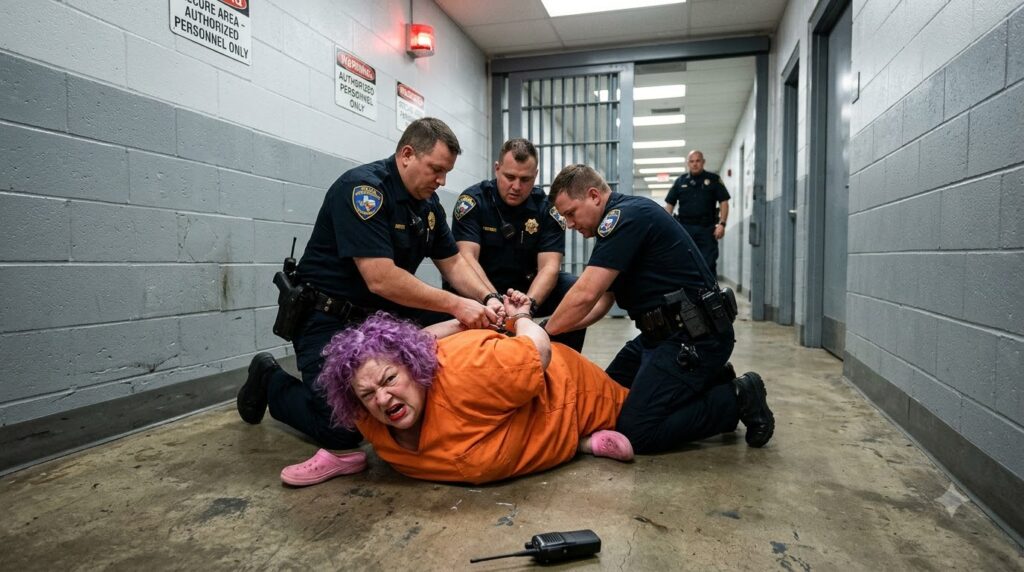
Chapter 9: The Door That Mattered
Nearly two years after the failed escape attempt, Karen stood before another secured door.
This time, she did not move until the officer instructed her to do so.
Her purple curls were shorter now, and the bright color had faded to a softer violet. She still wore an orange jumpsuit, though she had lost some weight under medical supervision after making gradual changes to her eating habits and mobility routine.
Her knees still hurt.
Her breathing was still difficult after long walks.
But she had become more patient with the physical limitations she once treated as insults.
The door led to the facility’s visitation area.
Emily was waiting on the other side.
It was their first face-to-face meeting since Karen’s trial.
Karen had imagined the reunion many times.
In some versions, Emily rushed into her arms.
In others, her daughter apologized for staying away.
But as Karen entered the visitation room, she knew those expectations belonged to the person she was trying to leave behind.
Emily stood beside a small table.
She looked older than Karen remembered.
There were faint lines around her eyes, and a few strands of gray in her brown hair.
Karen realized that while she had been consumed by her own imprisonment, her daughter’s life had continued.
Emily had worked, raised children, paid bills, celebrated birthdays, and faced ordinary disappointments without her mother’s presence.
Karen had missed those years.
She could not demand them back.
They sat across from each other.
For several moments, neither spoke.
Then Karen thanked Emily for coming.
Emily nodded.
The conversation began cautiously.
They discussed Sophie’s nursing studies, Ben’s progress in school, and Jason’s work.
Karen asked questions and listened to the answers.
When Emily mentioned that Sophie planned to remain in Oklahoma after graduation, Karen felt the familiar impulse to criticize the decision.
She wanted to say that Sophie was moving too far from family.
Instead, she asked whether Sophie was happy.
Emily smiled.
“She is.”
Karen let that be enough.
Later, Emily asked about the behavioral program.
Karen described the work she had been doing, including learning to recognize anger before acting on it.
She did not pretend she had become a different person overnight.
She admitted that she still struggled with resentment.
She still felt embarrassed when she remembered the gate incident.
And she still had moments when she wanted to blame the officers, the courts, or the people who had testified against her.
But she was learning to recognize those thoughts without acting on them.
Emily listened.
Then she asked a question that had remained between them for years.
“Do you understand why I couldn’t defend what you did?”
Karen looked down at her hands.
“Yes.”
She paused.
“I wanted you to choose me over the truth.”
Emily’s eyes filled with tears.
Karen continued quietly.
“That wasn’t fair to you.”
There was no dramatic embrace.
No declaration that everything had been forgiven.
But something important shifted.
For the first time, mother and daughter were speaking without Karen trying to control the outcome.
They remained together until the visit ended.
When the officer announced that time was up, Karen stood slowly.
Emily stood as well.
They hugged briefly, with the careful tenderness of people who wanted to reconnect but understood that trust was still fragile.
Karen watched her daughter walk toward the visitors’ exit.
Then she turned toward the secured interior door.
A correctional officer waited beside it.
Karen approached the designated line and stopped.
The officer checked the movement authorization.
The steel door opened.
Karen waited for the instruction.
Only then did she step through.
No alarm sounded.
No one was knocked down.
No handcuffs were needed.
The door closed behind her with a familiar metallic sound.
For most of her life, Karen had believed that freedom meant getting past anyone who stood in her way.
Now she understood that freedom also required self-control, accountability, and respect for boundaries.
She still had time left to serve.
She still owed restitution to the charity.
She still had relationships to repair, and some people might never choose to forgive her.
Those consequences were real.
But so was the possibility of living differently.
Several weeks later, Karen received a photograph from Emily.
It showed Sophie in her nursing-school uniform, standing beside Ben at a family gathering.
On the back, Emily had written:
We’re doing well. Keep doing the work.
Karen placed the photograph beside Richard’s picture.
She looked at the faces of the people she loved and thought about how close she had come to losing them entirely.
Then she sat at her small desk and began writing another letter.
Not to demand a favor.
Not to challenge a rule.
Not to accuse someone of mistreating her.
She wrote to Margaret Ellis, the director of the charity she had stolen from.
Karen acknowledged the money she had taken and the harm it had caused. She expressed regret that older adults had lost transportation services while the organization struggled to recover.
She explained that she intended to continue meeting her restitution obligations and hoped to contribute to the community in lawful ways after her release.
She did not ask Margaret to forgive her.
She did not ask for a response.
When she finished, she read the letter once more, signed her name, and prepared it for mailing through the facility’s approved process.
Outside her window, the afternoon sun fell across the recreation yard.
Beyond the fences, traffic moved along a distant Texas highway.
Karen could not reach that highway.
Not yet.
But for the first time since entering prison, she was no longer planning to force her way toward it.
She was planning how to live when she eventually arrived.
And that was a future no open gate could have given her.