
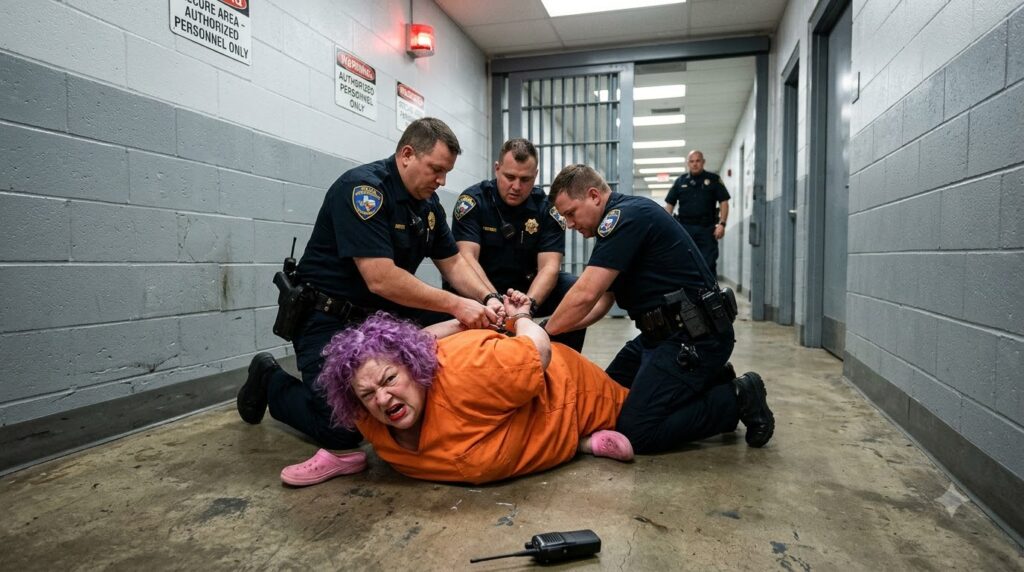
Chapter 7: The Person Behind the Purple Hair
The months following the gate incident were difficult for Karen.
Her new custody classification limited her movement.
She lost access to several privileges she had previously enjoyed.
Her pending criminal case required meetings with appointed counsel, document reviews, and court appearances.
The additional charge concerned the assault on Officer Mercer.
Her attorney, Rebecca Shaw, was an experienced public defender who had represented many clients facing offenses committed while incarcerated.
Shaw did not flatter Karen.
She reviewed the evidence, explained the legal issues, and made clear that the surveillance footage would be difficult to challenge on the basic sequence of events.
Karen wanted her to argue that Mercer had deliberately stepped into her path.
Shaw explained that an officer attempting to prevent unauthorized movement through a secured gate was performing a legitimate security function.
Karen wanted to claim she had been trying to escape mistreatment.
Shaw asked whether there was evidence of an immediate threat that could support such a defense.
Karen could identify no such threat.
She had been angry, frustrated, and desperate to leave.
Those feelings were real.
They did not make the assault lawful.
Eventually, Karen stopped interrupting long enough to hear her attorney’s advice.
The prosecution offered a negotiated resolution that would require Karen to acknowledge the assault and accept an additional custodial sentence, with the final terms subject to court approval.
Karen initially rejected it.
She said she would rather go to trial than admit she had done anything wrong.
Shaw explained the risks.
The footage was clear.
The officer had been injured.
The responding officers’ statements were consistent.
A trial could produce a less favorable outcome.
Karen asked for time to think.
During that period, she was assigned to a structured behavioral program for inmates with repeated disciplinary problems.
She attended reluctantly.
The facilitator, a licensed counselor named Denise Parker, was fifty-eight and had spent years working with people who struggled with anger, impulsivity, and control.
Parker did not attempt to humiliate Karen.
She asked participants to examine the difference between feelings and actions.
A person could feel disrespected without threatening someone.
A person could feel afraid without attacking someone.
A person could feel powerless without trying to control everyone nearby.
Karen resisted these ideas.
She argued that people who remained polite were often ignored.
Parker acknowledged that unfair treatment existed and that assertiveness could be necessary.
Then she asked Karen to describe the difference between standing up for herself and harming another person.
Karen could not provide a clear answer.
Over several sessions, the group discussed consequences.
Not simply punishment, but the effects actions had on other people.
One participant described losing contact with his adult son after years of broken promises.
Another spoke about the shame of having frightened his grandchildren.
Karen listened without volunteering much.
Then, during a session about family relationships, Parker asked participants to identify someone whose trust they had damaged.
Karen wrote Emily’s name.
She stared at it for a long time.
The exercise did not transform her overnight.
She still complained about staff decisions.
She still became defensive when challenged.
But she began noticing how often her first response to disappointment was anger.
She remembered Richard apologizing to people after her outbursts.
She remembered Emily crying at the kitchen table during arguments about money.
She remembered Sophie becoming quiet whenever Karen criticized her plans.
For years, Karen had interpreted their silence as agreement.
Now she wondered whether it had been exhaustion.
One afternoon, Parker asked Karen to describe the moment she charged the gate.
Karen began with the familiar explanation.
The gate had opened.
She had been frustrated.
She wanted to leave.
Parker asked what she believed would happen after she passed Mercer.
Karen hesitated.
She had never seriously considered that question.
She had seen an opening and imagined freedom waiting on the other side.
She had not thought about the second checkpoint.
She had not thought about the alarm.
She had not thought about Mercer falling.
She had wanted something, and she had moved toward it without considering who might be hurt.
That realization unsettled her.
For the first time, she could see the gate incident as part of a pattern rather than an isolated disaster.
She had spent decades treating obstacles as enemies.
And she had left a trail of damaged relationships behind her.