
Chapter 8: The Apology No One Demanded
Karen eventually accepted the negotiated resolution in her assault case.
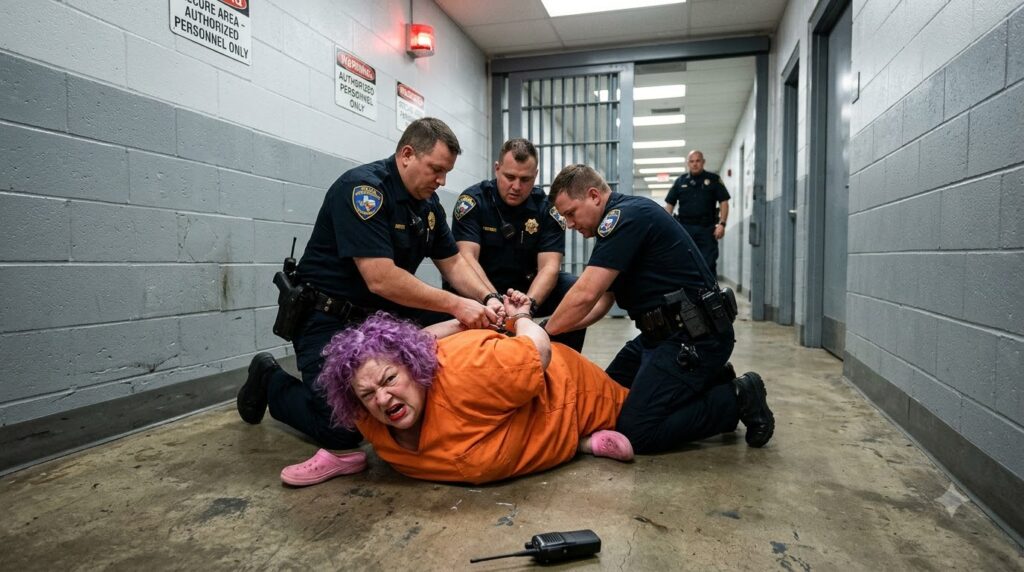
At the court hearing, she acknowledged that she had intentionally charged through the secured gate and struck Officer Mercer while he attempted to stop her.
The judge reviewed the agreement and imposed an additional sentence, with the applicable custody and release calculations left to correctional authorities.
Karen’s expected time in custody increased.
The courtroom was quiet as the judge explained the consequences.
Karen did not shout.
She did not accuse the prosecutor of persecution.
She sat with her hands folded and listened.
That alone would have surprised almost everyone who had known her before prison.
But the greater change came afterward.
During a counseling session, Parker asked Karen to write an account of the incident without using the words but, because they, or if only.
Karen struggled.
Every sentence seemed to lead toward an excuse.
She had been angry because the prison was unfair.
She had charged because Mercer blocked her.
She had resisted because the officers frightened her.
Parker encouraged her to describe her own actions first.
After several attempts, Karen wrote a paragraph.
She had seen the gate opening.
She had decided to run.
She had struck Mercer.
She had ignored orders to stop.
She had tried to force her way past three more officers.
And she had made the situation dangerous for everyone involved.
Karen read the paragraph aloud.
Her voice trembled.
It was the first time she had described the incident without assigning responsibility to someone else.
She then asked whether she could write a letter to Mercer.
Parker explained that any communication would need to follow facility procedures and that Mercer was under no obligation to receive or respond to it.
Karen agreed.
The letter took three days to finish.
She did not ask Mercer to forgive her.
She did not explain why she had been upset.
She acknowledged that she had deliberately struck him and that he had been injured while doing his job.
She wrote that she was sorry for the pain, the disruption to his family, and the fear the incident might have caused.
She ended by saying she understood that an apology could not undo what happened.
The letter was submitted through the approved process.
Mercer received it several weeks later.
By then, he had returned to work after completing medical treatment and rehabilitation.
His wrist had healed, although his shoulder occasionally ached after long shifts.
He read Karen’s letter at home.
Lauren watched him carefully.
“Do you believe her?”
Mercer thought for a moment.
“I believe she wrote it.”
That was all he could honestly say.
He had seen inmates make sincere changes.
He had also seen apologies offered in hopes of receiving favorable treatment.
He did not know which category Karen belonged in.
He chose not to respond.
But he kept the letter.
A month later, Karen wrote to Emily.
This letter was different from the others.
It contained no demands.
No accusations.
No threats to contact attorneys or politicians.
Karen acknowledged that she had blamed Emily for refusing to support false explanations during her trial.
She admitted that she had expected her daughter to sacrifice her own peace to protect her mother’s reputation.
She apologized for the pressure she had placed on Emily, Jason, and the children.
Most importantly, she did not ask for anything in return.
Emily read the letter in her living room.
She noticed the absence of familiar phrases.
There was no claim that Richard would have wanted her to help.
No suggestion that a good daughter owed her mother unconditional loyalty.
No attempt to make Emily responsible for Karen’s feelings.
Emily cried quietly.
Not because the letter erased the past.
It did not.
But because she had waited nearly forty years to hear her mother acknowledge that love and obedience were not the same thing.
Emily waited several days before replying.
She thanked Karen for the apology.
She told her that rebuilding trust would take time.
She was willing to continue writing and might consider a visit in the future.
But the boundaries protecting her family would remain.
Karen received the response without anger.
She was disappointed that Emily had not promised an immediate reunion.
Yet she understood, perhaps for the first time, that her daughter had the right to decide what kind of relationship she could safely maintain.
Karen placed the letter inside her locker.
Beside it, she kept the photograph of Richard at the Fourth of July picnic.
She had begun to understand that the people who loved her had never been obstacles to overcome.
They had been people she was supposed to cherish.