Chapter 2: The Emergency Karen Refused to Recognize
Forty minutes earlier, Briarwood Estates had been an ordinary, peaceful neighborhood on the outskirts of Raleigh, North Carolina.
The community consisted of 214 homes arranged around landscaped streets, a clubhouse, and a small artificial lake.
Most residents were retired professionals, longtime homeowners, or families who had moved there for quiet streets and dependable property values.
Karen Whitmore had served as HOA president for eleven years.
She treated the position less like a volunteer responsibility and more like a private office of government.
She had accumulated influence gradually.
First came stricter landscaping rules.
Then mandatory architectural inspections.
Later, she convinced the board to install a motorized entrance barrier and replace the original neighborhood security company with a smaller contractor willing to follow her instructions.
Karen insisted that every decision protected property values.
Some residents believed her.
Others had simply grown tired of arguing.
One of those residents was seventy-one-year-old Eleanor Price.
Eleanor had lived in Briarwood for seventeen years. Her late husband, Robert, had planted the two maple trees beside their driveway and built the wooden bench overlooking their backyard garden.
Since his death, Eleanor had worked hard to maintain the life they had created.
She attended church, volunteered at the library, and occasionally baked banana bread for her neighbors.
She also had a heart condition.
That morning, while carrying a laundry basket from her bedroom, Eleanor experienced sudden chest pressure and severe shortness of breath.
She managed to call 911 before sitting on the floor.
Her neighbor, Patricia Collins, heard the emergency through an open window and rushed over.
Patricia found Eleanor pale, sweating, and frightened.
The dispatcher instructed them to remain on the line while emergency responders were sent.
Officer Daniel Mercer was nearby when dispatch requested assistance with access to the gated neighborhood.
An ambulance was also responding from a station several miles away.
Mercer reached the entrance first.
Normally, the guard could admit emergency vehicles immediately.
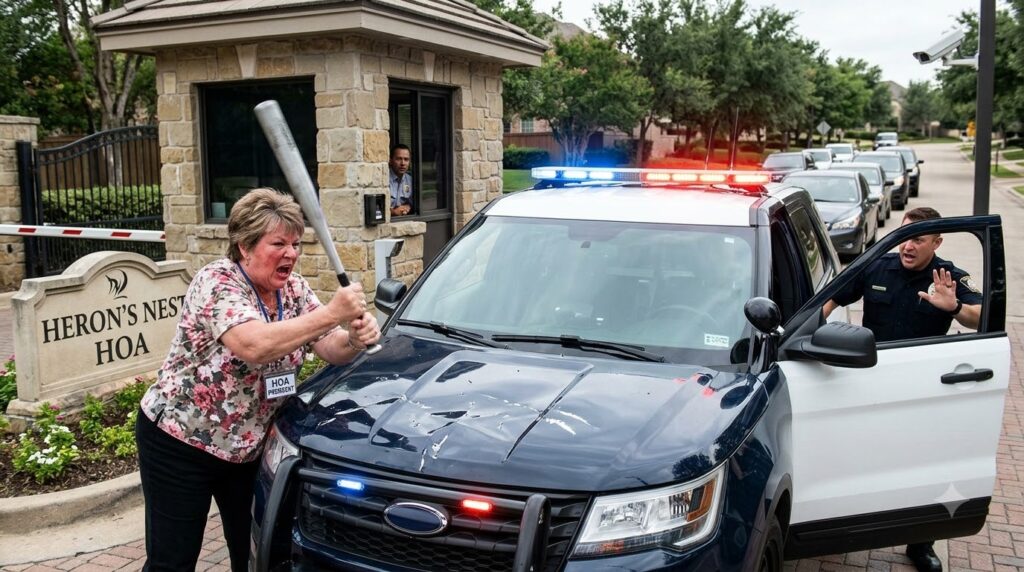
But Karen had arrived minutes earlier to investigate what she called an unauthorized delivery.
She had been carrying a metal baseball bat in her SUV, supposedly because she had recently found damage near the clubhouse storage shed.
When Luis explained that police needed access for a medical emergency, Karen refused.
She claimed the emergency authorization procedure had to be verified through the HOA office.
Luis pointed out that emergency responders were exempt from ordinary visitor restrictions.
Karen ordered him to keep the gate closed.
The disagreement escalated when Mercer activated his emergency lights and requested entry.
Karen stepped into his path.
She insisted that he wait while she contacted the HOA attorney.
Mercer explained that someone inside the neighborhood might be suffering a life-threatening medical event.
Karen dismissed his warning.
She believed the officer was attempting to intimidate her.
When he told her to clear the entrance, she returned to her vehicle, retrieved the baseball bat, and marched toward the police SUV.
Luis had already activated the entrance camera’s event marker, preserving the relevant footage.
He could not have imagined how important that decision would become.
Now, with Mercer recovering on the pavement and the gate finally open, Luis watched the road for additional emergency vehicles.
The ambulance arrived first.
Its driver slowed at the sight of the damaged police SUV and the officer kneeling beside it.
Mercer waved the crew through.
“Medical emergency inside. Keep going.”
The ambulance passed beneath the raised barrier.
Karen shouted something about trespassing.
Nobody stopped.
For the first time in years, her commands carried no authority.
Patricia was waiting outside Eleanor’s home when the paramedics arrived.
They began assessing Eleanor immediately and prepared her for transport.
Eleanor was still conscious, but her condition was serious.
Back at the gate, Karen watched the ambulance disappear around the curve.
She seemed less concerned about the patient than about the fact that Luis had opened the entrance without her permission.
She approached the guard booth.
“You are finished here,” she told him.
Luis remained seated.
“I opened the gate for emergency responders.”
“You work for this association.”
“I work for the security company, ma’am. And I have instructions for emergencies.”
Karen’s eyes narrowed.
“You’ll regret this.”
Luis looked at the recording monitor.
The footage had already been preserved locally, and the system was configured to retain incident clips on a separate recorder.
He did not tell Karen that.
Instead, he wrote down the time.
10:14 a.m.
The morning Briarwood’s carefully maintained appearance of order finally cracked.