Chapter 6: The Video Everyone Wanted to See
The surveillance recording became central to the criminal case.
Investigators obtained a verified copy and documented its handling.
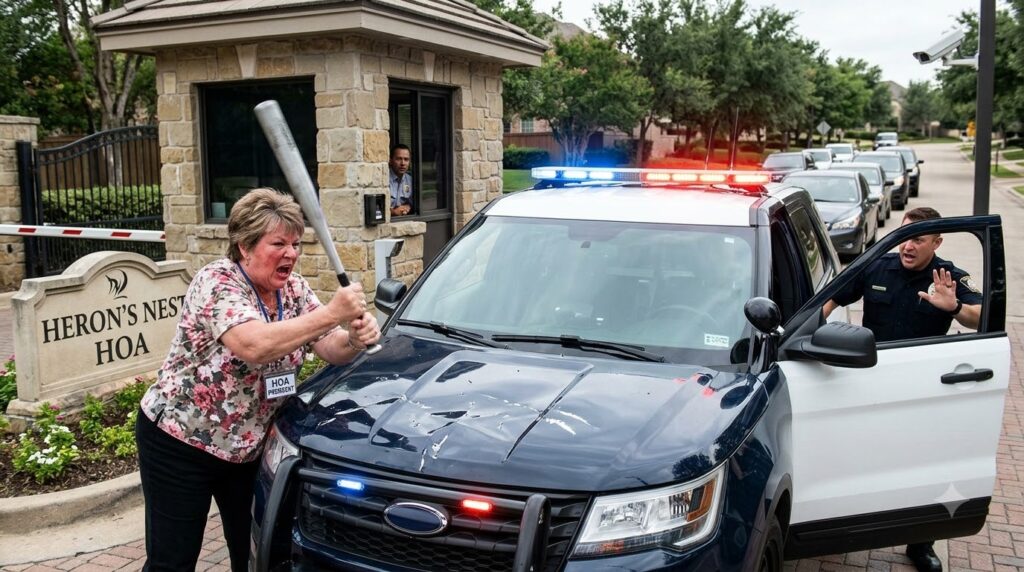
The footage clearly showed the two bat strikes, the damage to the police SUV, the single punch, and Mercer’s fall.
It also showed the gate rising only after Luis activated the emergency override.
Karen’s attorney, Richard Sloan, reviewed the evidence with her.
Richard was an experienced defense lawyer who had represented clients accused of everything from financial misconduct to violent offenses.
He was not easily surprised.
But he understood immediately that the recording created serious problems for Karen’s defense.
Her initial claim that the police SUV had driven toward her was contradicted by the video.
Her assertion that Mercer had attacked her first was equally unsupported.
Richard explained the potential consequences.
Assaulting an officer, damaging government property, and interfering with emergency operations could result in substantial penalties, depending on the charges ultimately filed and the court’s findings.
He advised Karen to stop discussing the case publicly.
He also warned her not to contact witnesses or attempt to influence the HOA’s records.
Karen listened impatiently.
Then she asked whether he could force the security company to delete the recording.
Richard stared at her.
“No.”
She insisted that the cameras belonged to the association.
He explained that ownership did not give her the right to destroy evidence.
Karen leaned back.
For the first time, she seemed to understand that legal proceedings did not operate like HOA meetings.
She could not simply announce a rule and expect everyone to obey.
Meanwhile, a short cellphone recording of the aftermath circulated online.
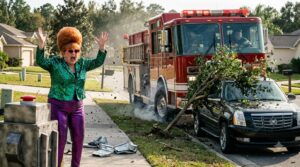
It showed Karen shouting beside the damaged SUV while Mercer recovered on the pavement.
The clip attracted attention from local news outlets.
Reporters contacted the police department and HOA management company.
Thomas issued a brief statement confirming that Karen had been removed as president and that the association was cooperating with investigators.
He did not speculate about the criminal case.
Residents were divided over the publicity.
Some believed the neighborhood should remain quiet until the legal process concluded.
Others argued that years of intimidation had finally become impossible to ignore.
At a special homeowners meeting, more than 130 residents attended.
The clubhouse could not accommodate everyone, so the meeting was moved to a nearby community center.
Thomas stood at the front beside Margaret Bell.
He explained the steps already taken.
Emergency access procedures had been reviewed.
The gate system had been tested.
Security guards had received written confirmation that they could authorize emergency entry without HOA approval.
The board was also examining the association’s financial records.
Then Thomas invited questions.
A retired firefighter named George Benton stood.
He was seventy-three and had lived in Briarwood since its construction.
George spoke slowly.
He remembered when the neighborhood had no gate.
Children rode bicycles between houses.
Neighbors borrowed tools.
Residents left casseroles on porches when someone was ill.
He did not oppose security.
But he questioned whether Briarwood had allowed its rules to become more important than its people.
Several residents nodded.
Then Luis Ramirez stood near the back of the room.
He had not planned to speak.
But Thomas invited him forward.
Luis explained that he had been afraid of losing his job when Karen ordered him to keep the barrier closed.
He had a mortgage, a wife with medical expenses, and a daughter finishing college.
He could not afford unemployment.
Still, when he saw the officer fall and knew emergency responders needed access, he had pressed the override.
The room remained silent.
Luis looked down at his hands.
“I did what the emergency procedure said to do.”
Then someone began applauding.
Within seconds, the entire room joined in.
Luis looked embarrassed.
He had not come for recognition.
But the applause meant something important.
For years, Karen had made him feel replaceable.
Now the residents were telling him that his judgment mattered.
At the end of the meeting, the homeowners approved a formal review of the association’s governance and supported a special election for board seats under the bylaws.
Thomas understood that the neighborhood was changing.
The gate had become the symbol of a larger problem.
And Briarwood was finally prepared to confront it.