Chapter 4: A Neighborhood Begins Asking Questions
Eleanor survived the first night.
Doctors performed an urgent procedure to restore blood flow to her heart. She remained in the cardiac unit under close observation.
Her daughter, Susan Price, sat beside her bed holding the same hand that had guided her across streets when she was a child.
Susan was fifty-one, a public school administrator who lived forty minutes away.
She had always worried about her mother living alone.
But Eleanor loved Briarwood.
She knew her neighbors. She felt safe there. She believed that if something happened, someone would help.
Now Susan was struggling with the possibility that neighborhood rules had delayed the help her mother needed.
The doctors could not determine whether the delay had changed Eleanor’s medical outcome.
They were careful not to speculate.
Susan understood that.
But the uncertainty did not erase her anger.
The following afternoon, she visited the Briarwood management office.
She requested the HOA’s emergency access policy, gate operating procedures, and any records related to the incident.
The property manager, Melissa Grant, appeared visibly uncomfortable.
Melissa had worked for Briarwood’s management company for four years.
She had repeatedly warned the board that Karen’s increasingly restrictive gate policies could create liability.
Several warnings had been discussed during meetings.
Others had been ignored.
Melissa gave Susan the current written policy.
It contained a clear provision.
Emergency responders were to receive immediate access upon verification of an active response.
No HOA officer was required to approve entry.
Susan read the paragraph twice.
“Then why was the gate closed?”
Melissa did not have an answer.
That evening, Briarwood’s remaining four board members held an emergency meeting.
Vice President Thomas Reed chaired it.
Thomas was sixty-seven, a retired accountant who had spent years avoiding direct conflict with Karen.
He had often disagreed with her privately but voted with her publicly to keep meetings peaceful.
Now he regretted that habit.
The association’s attorney, Margaret Bell, joined by video conference.
She made the board’s responsibilities clear.
They needed to preserve records, cooperate with lawful investigations, protect residents’ safety, and avoid interfering with witnesses.
Karen’s position as HOA president did not give her authority over police officers or emergency medical personnel.
Nor did it allow her to override the written emergency access policy.
Thomas asked whether the board could suspend Karen from leadership.
Margaret explained that the answer depended on the governing documents and applicable law.
They reviewed the bylaws.
The board could remove an officer from the presidency by majority vote, although removing someone from the elected board itself required a separate process.
The vote was unanimous.
Karen Whitmore was removed as HOA president, effective immediately.
Thomas became acting president.
The board also directed management to preserve all records related to gate operations, security contracts, and emergency procedures.
Then Melissa raised a concern.
She had found several unusual charges in the association’s maintenance records.
Over the previous eighteen months, Karen had approved a series of payments for gate repairs, camera upgrades, and emergency equipment inspections.
Some invoices contained vague descriptions.
Others appeared to duplicate services.
The total exceeded $38,000.
Thomas frowned.
“Why are we hearing about this now?”
Melissa explained that Karen had been given limited spending authority for urgent maintenance. Several charges had been processed under that authority, while others had been approved through procedures the board now needed to review.
Margaret advised them not to assume wrongdoing without examining the records.
Thomas agreed.
But he also requested an independent financial review.
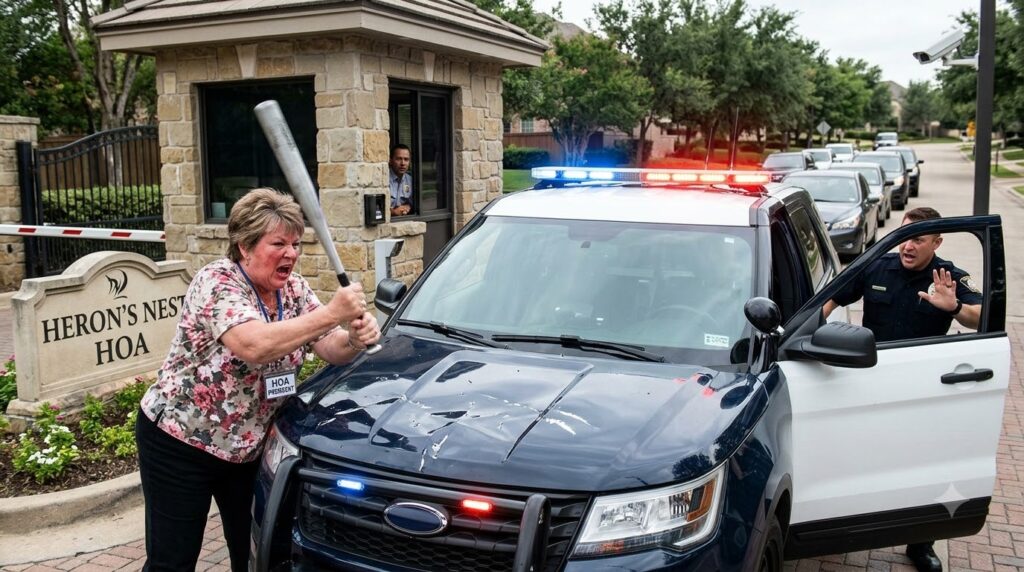
Meanwhile, Karen had been released from custody under court-imposed conditions.
She returned home late that evening.
Her husband, Frank, was waiting in the kitchen.
Frank Whitmore was sixty-five, a retired insurance adjuster who had spent most of his marriage avoiding his wife’s disputes.
He had watched her become increasingly consumed by the HOA.
At first, he had admired her dedication.
Later, he had worried about her anger.
Now he had seen photographs of her being arrested.
Karen dropped her purse on the counter.
“The whole neighborhood has turned against me.”
Frank looked at her swollen knuckles.
“Did you hit that officer?”
Karen said nothing.
Frank lowered his eyes.
He had spent years telling himself that Karen’s temper was merely a difficult personality trait.
Now he understood that silence had consequences.
And for the first time in their forty-year marriage, he told her he would not defend what she had done.