Chapter 7: The Price of Being in Charge
Karen’s criminal case moved slowly through the courts.
Her attorney negotiated with prosecutors while investigators completed their reports.
Officer Mercer had returned to duty after medical evaluation and a brief recovery period.
His facial bruising faded.
His shoulder remained sore for several weeks, but he suffered no lasting disability.
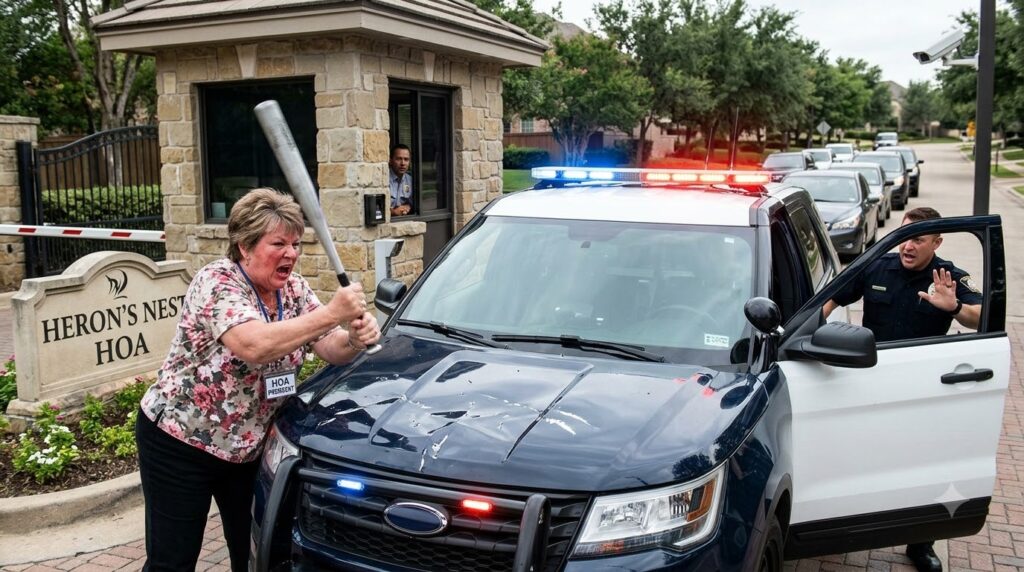
The police department repaired the damaged SUV after documenting the evidence.
The repair bill included the hood, paintwork, inspection, and related labor.
Karen was notified that restitution would be sought.
The amount was far greater than she had expected.
She had imagined the damage as two dents in a piece of metal.
The invoice forced her to confront the financial consequences of her anger.
At the same time, the HOA financial investigation reached a more complicated conclusion.
Some of Bradley Whitmore’s invoices were supported by legitimate work.
Others lacked adequate documentation.
The independent review found that Karen had failed to disclose a family relationship and had bypassed required approval procedures.
The evidence did not establish that every disputed payment was fraudulent.
However, the board concluded that the association had paid for services without proper authorization and that several charges required reimbursement or further resolution.
Through counsel, Bradley agreed to return the amounts that could not be adequately supported, without admitting intentional wrongdoing.
The board adopted stronger purchasing controls.
Karen was no longer authorized to act on the association’s behalf.
Her former colleagues also initiated the process required to determine whether she should remain on the elected board.
At the next properly noticed membership vote, homeowners removed her from her board seat in accordance with the association’s governing procedures.
The result was decisive.
Karen had lost not only the presidency but also her place in the organization she had dominated for eleven years.
She received the news while sitting at her kitchen table.
Frank was washing dishes.
She read the notice twice.
Then she folded it and placed it beside her coffee cup.
“They’ve erased everything I did for that neighborhood.”
Frank turned off the faucet.
“Not everything.”
She looked up.
“People remember the good things, too. But the good things don’t cancel what happened.”
Karen’s eyes filled with tears.
She had expected him to comfort her.
Instead, he offered something more difficult.
The truth.
Over the following weeks, she began attending counseling at her attorney’s recommendation.
Initially, she treated the sessions as another requirement to complete.
She complained about the police.
She complained about Thomas.
She complained about residents who had supported her for years and then voted against her.
Her counselor, Dr. Helen Foster, did not argue with her.
Instead, she asked Karen to describe the moment she picked up the bat.
Karen remembered the heat of the pavement.
The flashing lights.
The officer telling her to move.
She remembered feeling humiliated in front of Luis.
She remembered believing that if she stepped aside, everyone would see that her authority meant nothing.
Dr. Foster asked what would actually have happened if she had opened the gate.
Karen struggled to answer.
Eventually, she admitted the obvious.
The officer would have driven through.
The ambulance would have reached Eleanor.
And the morning would have continued.
There would have been no damaged SUV.
No injured officer.
No arrest.
No national embarrassment.
No ruined reputation.
Karen sat silently for a long time.
Then she whispered, “I couldn’t stand being told no.”
It was the first time she had described her own actions without blaming someone else.
Dr. Foster did not tell her that admitting the truth erased the harm.
It did not.
But it gave them somewhere to begin.
Meanwhile, Susan Price received an update about the criminal case.
She learned that Karen’s attorney had requested an opportunity to discuss a possible plea resolution.
Susan was not responsible for deciding the charges.
But prosecutors wanted to understand the effect of the gate obstruction on Eleanor and her family.
Susan prepared a written statement.
She did not exaggerate.
She did not claim that Karen had caused her mother’s heart attack.
She described the fear of learning that emergency responders had been delayed.
She described the uncertainty that followed.
And she described the damage to her mother’s sense of security.
At the bottom of the page, she wrote one sentence.
My mother deserved immediate help, not a debate over who controlled the gate.