Chapter 5: The Records Behind the Gate
The independent accountant arrived at Briarwood the following Monday.
Her name was Denise Walker, and she specialized in nonprofit organizations and community associations.
She began with the gate maintenance accounts.
At first, the irregularities appeared administrative.
Several invoices lacked supporting work orders.
Some purchases had been approved without competitive bids.
A security equipment vendor had billed for replacement components that did not appear in the maintenance logs.
Then Denise found something more troubling.
A company called Whitmore Property Solutions had received payments totaling $14,600 over eighteen months.
The invoices described consulting, vendor coordination, and emergency maintenance supervision.
The company was registered to an address associated with Karen’s adult nephew, Bradley Whitmore.
Bradley was thirty-nine and operated a small property services business.
The relationship had not been disclosed in the board’s conflict-of-interest records.
That did not automatically prove the invoices were fraudulent.
But it raised questions the board could no longer ignore.
Denise requested supporting documentation.
Bradley supplied several emails and service descriptions, but some records were incomplete.
Karen had approved the payments.
Thomas remembered her describing the vendor as an outside specialist who could respond faster than the association’s regular contractors.
He had not known about the family connection.
The board referred the findings to its attorney and authorized further investigation.
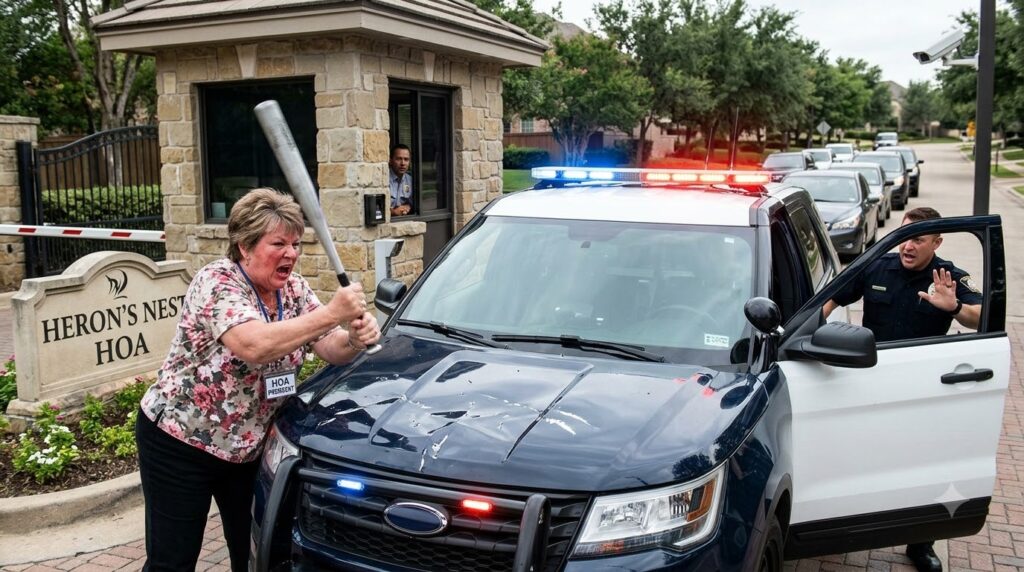
The police were separately investigating the gate incident.
The two matters remained distinct, although investigators were informed of potentially relevant evidence.
Karen learned about the financial review through a letter from the HOA attorney.
She immediately called Bradley.
He told her that his company had performed legitimate work and that he had invoices to support the services.
Karen demanded that he stop cooperating with the board.
Bradley refused.
He had a business and a family to protect.
For years, Karen had expected relatives to follow her instructions without question.
Now even her nephew was resisting.
Her isolation deepened.
Neighbors who once greeted her warmly began avoiding her driveway.
The gardening committee removed her from its email distribution after she sent a series of angry messages.
The clubhouse manager canceled her standing reservation for HOA leadership meetings.
None of those actions carried the weight of criminal charges.
But together, they revealed how much of Karen’s identity had become attached to her position.
Without the presidency, she no longer knew how to behave among people she could not command.
One afternoon, Frank found her sitting at the dining room table surrounded by printed emails.
She was preparing a statement accusing the police, security company, and HOA board of conspiring against her.
Frank read the first page.
It contained several claims he knew were false.
He placed the paper down.
“Karen, you need to stop blaming everyone else.”
She glared at him.
“You’re supposed to be on my side.”
“I am your husband. That doesn’t mean I have to agree with you.”
She turned away.
Frank sat across from her.
He reminded her of the woman he had married.
She had been a hardworking office manager, a devoted mother, and someone who organized meals for sick neighbors.
She had once cared deeply about helping people.
Somewhere along the way, that desire to help had become a need to control.
Karen did not answer.
Frank continued.
“An elderly woman needed an ambulance. You made the gate more important than her life.”
Those words finally reached her.
Not enough to produce an apology.
Not yet.
But enough that she stopped writing.
Across town, Eleanor was beginning cardiac rehabilitation.
She could walk short distances with assistance.
Her recovery would take time, and her doctors had warned her that fatigue and anxiety were common after a heart attack.
Susan had temporarily moved into Eleanor’s guest bedroom.
One evening, Eleanor asked what had happened at the gate.
Susan hesitated.
Then she explained.
Eleanor listened quietly.
When Susan finished, her mother looked toward the window.
“I always thought those gates were there to keep us safe.”
Susan squeezed her hand.
“They should have been.”
Eleanor considered that.
Then she said something Susan would remember for years.
“A neighborhood isn’t safe because somebody controls the entrance. It’s safe because people care what happens on the other side.”