Chapter 9: What the Gate Was Really For
One year after the confrontation, Briarwood Estates looked much the same from the road.
The entrance pillars were still made of pale stone.
The flower beds were neatly maintained.
The artificial lake still reflected the evening sun.
But the neighborhood operated differently.
The HOA had adopted a revised governance policy requiring clearer financial oversight, documented vendor approvals, and annual training for board members.
Emergency access procedures were posted in the security booth and tested regularly.
The security company had upgraded its emergency response coordination system.
No individual board member could unilaterally block authorized emergency vehicles.
Thomas Reed had declined to seek another term as president.
Instead, the homeowners elected Patricia Collins.
Patricia was sixty-nine, a retired nurse who believed community leadership should be practical, transparent, and largely unremarkable.
She held open meetings.
She answered residents’ questions.
And she refused to let minor disagreements become personal battles.
The association’s financial review had been completed, disputed payments had been addressed through documented agreements, and the board had implemented the accountant’s recommendations.
Residents were still occasionally annoyed by landscaping notices and parking restrictions.
No neighborhood was free from disagreements.
But people had begun speaking to one another again.
They organized a monthly potluck.
A volunteer group helped elderly residents with small household tasks.
The clubhouse hosted a free workshop on emergency preparedness.
Luis Ramirez remained at the entrance booth.
His employer had recognized his handling of the incident, and the HOA had formally thanked him for following emergency procedures.
He appreciated the recognition.
But he was happiest that his job had become ordinary again.
Most mornings, he waved to familiar residents and greeted delivery drivers.
Sometimes Eleanor Price stopped to say hello.
Her recovery had been gradual.
She still attended cardiac rehabilitation appointments and took her medications carefully.
But she had returned to gardening.
Her maple trees were thriving.
And the wooden bench Robert had built remained her favorite place to sit.
One spring afternoon, Eleanor brought Luis a small container of homemade banana bread.
He thanked her.
She looked toward the barrier.
“Funny thing,” she said. “I used to think that gate was the most important part of this neighborhood.”
Luis smiled.
“What do you think now?”
Eleanor glanced toward the houses beyond the entrance.
“The people.”
Across Briarwood, Karen Whitmore was living a quieter life.
She no longer attended HOA meetings.
She had completed her court-ordered community service and continued complying with the remaining conditions of her sentence.
Her relationship with Frank had been strained, but they were working to rebuild it.
He had stopped excusing her anger.
She had begun learning to recognize it before it became someone else’s problem.
The process was uncomfortable.
Some neighbors still avoided her.
Others offered polite greetings but kept their distance.
Karen had learned that an apology did not entitle her to forgiveness.
Trust, once broken, could take years to repair.
One afternoon, she was walking near the neighborhood lake when she saw Eleanor sitting on the bench beneath the maple trees.
Karen almost turned around.
Then she stopped.
She approached slowly, keeping a respectful distance.
“Mrs. Price?”
Eleanor looked up.
Karen’s hands trembled slightly.
“I know I apologized in court. But I wanted to tell you again that I’m sorry.”
Eleanor studied her face.
She did not offer immediate forgiveness.
She did not pretend the past had disappeared.
Instead, she said, “I hope you mean that.”
“I do.”
Eleanor nodded.
“Then live like you mean it.”
Karen stood quietly for a moment.
There was nothing more to say.
She continued along the path.
It was a small exchange.
No audience.
No applause.
No dramatic reconciliation.
But for Karen, it mattered more than the speeches she had once delivered from the HOA president’s chair.
She had finally encountered a situation where she could not demand the outcome.
She could only accept responsibility for her part.
Several weeks later, Briarwood held its annual neighborhood picnic.
Families gathered near the clubhouse.
Retirees brought folding chairs.
Children played games on the lawn.
Patricia Collins thanked the volunteers and reminded residents about the upcoming emergency preparedness workshop.
There were no speeches about Karen.
No public celebration of her downfall.
The community had moved forward.
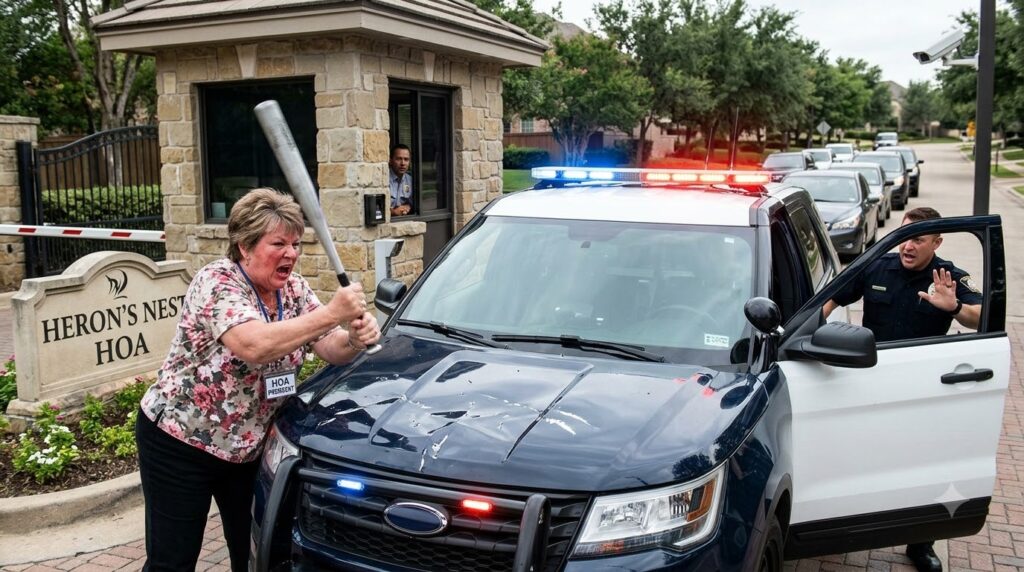
Near the entrance, Officer Daniel Mercer stopped briefly during a routine patrol.
His replacement SUV was clean and undamaged.
Luis recognized him and raised the barrier.
Mercer rolled down his window.
“Quiet day?”
Luis smiled.
“Just the way we like it.”
Mercer drove through.
No confrontation.
No argument.
No delay.
A few minutes later, an ambulance approached the entrance on a non-emergency transport call.
Luis confirmed the vehicle’s destination and opened the gate without hesitation.
The barrier rose smoothly.
The ambulance passed through.
And nobody questioned whether it had the right to enter.
That evening, Eleanor sat on Robert’s bench watching the sun settle behind the houses.
Susan joined her with two cups of tea.
From where they sat, the entrance gate was barely visible through the trees.
Eleanor remembered the fear of her heart attack, the long recovery, and the strange chain of events that had forced Briarwood to examine itself.
She thought about Luis pressing the emergency override despite Karen’s threats.
She thought about Mercer getting back to his feet after being struck.
She thought about the neighbors who had finally found the courage to demand better leadership.
And she understood something that had taken the entire community years to learn.
Authority was not the same as respect.
Rules were not the same as justice.
And protecting a neighborhood meant more than deciding who could pass through its gates.
It meant knowing when to open them.
The following morning, a small sign appeared inside the guard booth.
Patricia had asked Luis to place it beside the emergency controls.
It contained only one sentence:
“When someone needs help, people come before procedures.”
Luis read it, smiled, and began his shift.
Outside, the sun rose over Briarwood Estates.
The gate opened.
And life went on.