Chapter 2: The Rule That Didn’t Exist
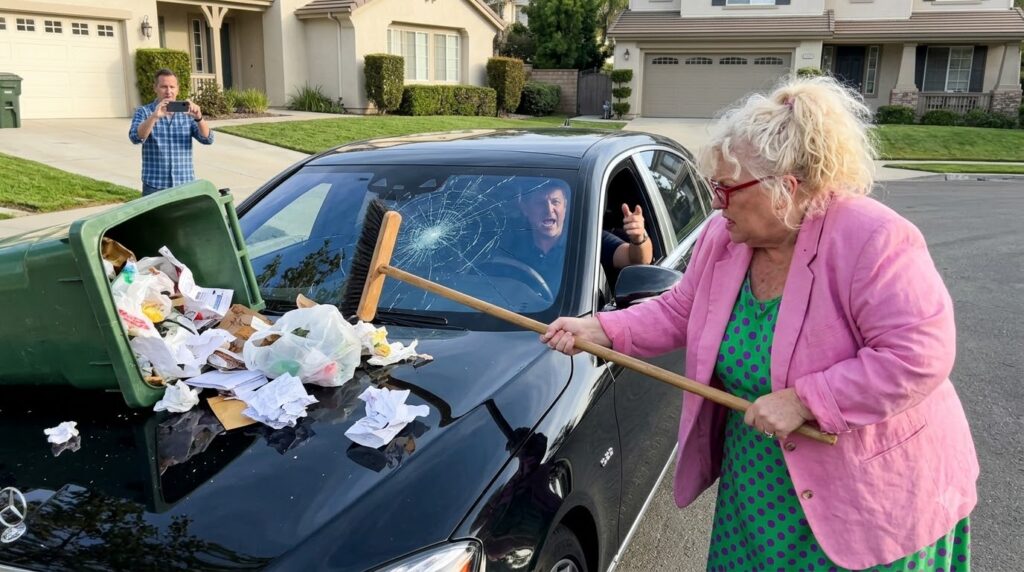
Two Sacramento County sheriff’s deputies arrived approximately eighteen minutes after Daniel’s call.
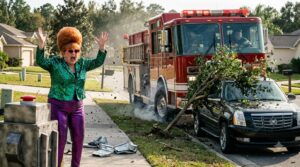
By then, Karen had repositioned herself beside the garbage bin, apparently hoping to appear calm and reasonable.
She had even retrieved her clipboard from a nearby flower bed.
Daniel remained outside the Maybach, standing near the driver’s door.
He had resisted the urge to touch the damaged windshield or remove the garbage.
Michael had advised him to leave everything exactly as it was.
The first deputy, Officer Laura Ramirez, surveyed the scene.
Her eyes moved from the overturned garbage bin to the shattered windshield, then to the broom handle lying near Karen’s feet.
“Who owns the vehicle?”
Daniel raised his hand.
“Who caused the damage?”
Karen immediately stepped forward.
“I am the HOA president, Officer. This resident has repeatedly violated our transportation restrictions.”
Ramirez looked at the windshield.
“Did you strike his vehicle?”
Karen hesitated.
“I was carrying out an enforcement action.”
“That wasn’t my question.”
Karen’s expression tightened.
She insisted Daniel had ignored official warnings and had driven his car through a restricted portion of the neighborhood.
Daniel explained that the Maybach had been moving along his own driveway toward the community street.
He had stopped before Karen dumped the garbage.
Ramirez asked whether anyone had been injured.
Everyone confirmed that nobody had.
Then Michael stepped forward.
“I have the entire incident on video.”
He played the recording.
The first image showed Daniel’s Maybach approaching slowly.
Karen stepped in front of it.
The car stopped.
The garbage bin tipped forward.
Then came the two unmistakable strikes.
Ramirez watched without speaking.
Her partner, Deputy James Holloway, took photographs of the damage and began collecting statements.
When the recording ended, Ramirez looked directly at Karen.
“Mrs. Whitmore, you deliberately damaged this man’s vehicle.”
Karen lifted her chin.
“The HOA has enforcement authority.”
“An HOA does not have authority to smash someone’s windshield.”
For the first time that morning, Karen seemed uncertain how to respond.
She reached for her clipboard.
“I have documentation.”
Ramirez accepted the papers.
They consisted of three violation notices, each signed by Karen.
The first alleged that Daniel’s vehicle was excessively large.
The second claimed the Maybach created a neighborhood safety hazard.
The third warned of potential towing and additional fines.
None cited a specific provision of the HOA’s governing documents.
Ramirez returned the papers.
“These are matters for your association and its attorneys. They don’t authorize property destruction.”
Karen’s cheeks reddened.
She looked toward the nearby houses, where several residents had emerged onto their porches.
The neighborhood was watching.
That appeared to bother her more than the damaged car.
Daniel spent the rest of the morning dealing with the consequences.
The deputies documented the incident, preserved the video evidence, and explained that their report would be forwarded for review.
They did not promise an immediate arrest.
Because no one had been injured and Karen remained cooperative during their investigation, they completed their initial work at the scene.
Daniel arranged for the Maybach to be transported to a Mercedes-Benz-approved repair facility.
The service manager warned that the windshield replacement would be expensive.
The car contained advanced driver-assistance cameras, sensors, and specialized glass requiring professional calibration.
The preliminary estimate exceeded $12,000.
Additional inspection could reveal more damage.
Daniel felt physically sick.
He could afford repairs, but that was not the point.
Someone had attacked his property in broad daylight because she believed a volunteer position gave her unlimited power.
That evening, Rebecca sat beside him at their kitchen island while he reviewed photographs of the damage.
She was fifty-three, practical, compassionate, and considerably less patient with bullies than her husband.
“Daniel, this isn’t about the car anymore.”
He looked at her.
“She could have hurt you.”
He nodded.
Rebecca reached across the counter and took his hand.
“You’ve spent six years trying to avoid trouble with that woman. Maybe it’s time someone made her answer for what she’s doing.”
Daniel knew she was right.
But he still wanted to understand something.
Why had Karen become so obsessed with his car?
He opened the HOA’s governing documents, which he had downloaded weeks earlier.
He searched for vehicle restrictions.
There were rules about commercial trucks, recreational vehicles, trailers, and abandoned automobiles.
There was nothing prohibiting luxury sedans.
Nothing about vehicle value.
Nothing about the Maybach’s length.
And nothing authorizing the HOA president to stop residents from leaving their own driveways.
He printed the relevant pages.
Then he opened Karen’s latest warning notice.
Near the bottom, beneath her signature, was a sentence he had previously overlooked.
“Noncompliance may result in an emergency special assessment to cover neighborhood safety improvements.”
Daniel frowned.
A special assessment?
For his car?
He read the sentence again.
Then his phone rang.
It was Michael Bennett.
“I found something in the HOA financial reports,” Michael said.
“Something you need to see before the next board meeting.”