
Chapter 5: The Company Behind the Complaints
Daniel brought Evelyn’s documents to Sarah the next morning.
Sarah examined them carefully.
The name Christopher Whitmore did not prove wrongdoing by itself.
A relative could legally operate a company providing legitimate services.
The important questions were whether the relationship had been disclosed, whether the contract had been properly approved, and whether the association had received the services it paid for.
Sarah began with publicly available business records.
Evergreen Community Solutions was a California limited liability company.
Its listed business address was a small commercial office in Roseville.
The company’s registered agent was Christopher Whitmore.
He was forty-two.
Karen’s only son.
Daniel stared at the information on Sarah’s computer.
“She pushed the board to hire her own son’s company?”
“That appears to be the connection,” Sarah replied. “Now we need to establish what the board knew.”
The next several days were frustrating.
The HOA management company provided some financial records but withheld others pending review.
Meeting minutes showed that Evergreen’s contract had been approved during a board meeting two years earlier.
Karen had recommended the company.
The minutes did not mention her relationship to Christopher.
Robert Hayes, contacted through the association’s attorney, confirmed that he had not known Evergreen was owned by Karen’s son.
Linda Foster said the same.
The remaining director, Patricia Sloan, recalled Karen describing Christopher as an experienced compliance consultant.
But Patricia had assumed he was unrelated.
The board had never been presented with competing bids.
Daniel found that detail particularly troubling.
In his construction business, vendor selection required documentation, pricing comparisons, and disclosure of potential conflicts.
He knew how easily financial decisions could become compromised when personal relationships were concealed.
Still, he refused to assume every Evergreen payment was fraudulent.
Sarah agreed.
They needed more than suspicion.
The breakthrough came from an unexpected source.
A former Evergreen employee contacted Michael after hearing about the clubhouse meeting.
Her name was Denise Walker.
She had worked part-time for Christopher Whitmore for approximately eight months.
Denise was fifty-nine, recently divorced, and employed as an administrative assistant at a medical office.
She had left Evergreen after repeated disputes over unpaid wages.
She agreed to meet Sarah privately.
Denise described Evergreen as a small operation with several clients.
Some services were legitimate.
The company prepared compliance letters, maintained inspection records, and coordinated outside contractors.
But Willow Creek Estates was different.
According to Denise, Karen personally supplied many of the alleged violations.
She sent photographs, names, addresses, and instructions about which homeowners should receive warnings.
Denise recalled one email concerning Daniel’s Maybach.
Karen had described the vehicle as a “high-value nuisance” that could be used to demonstrate the need for stricter entrance controls.
Another message suggested that residents would support a special assessment if they believed expensive vehicles created security risks.
Denise had retained copies of certain emails from her employment dispute.
Sarah reviewed them carefully and arranged for their authenticity to be assessed before relying on them.
The messages did not establish that Christopher had stolen association funds.
They did, however, suggest that the vehicle controversy had been deliberately exaggerated to promote additional security spending.
One email was particularly revealing.
Karen had written that Daniel was “the perfect example” because his car would attract attention.
She wanted photographs of the Maybach included in a neighborhood security presentation.
Daniel read the message twice.
He felt a strange combination of anger and relief.
For weeks, he had wondered whether he had unknowingly violated some obscure rule.
Now he understood that the car had served a purpose in Karen’s campaign.
It was visible.
Expensive.
Easy to photograph.
And likely to provoke opinions among residents.
Karen had turned it into a symbol.
Then, when Daniel refused to accept her invented restriction, she had escalated.
Sarah set the papers aside.
“This changes the HOA dispute significantly.”
Daniel looked at her.
“Can we stop the assessment?”
“Possibly. But the board needs to act, and we need a proper review of the contract.”
She recommended that concerned homeowners submit a formal request for an independent financial examination and that the board suspend new Evergreen expenditures while the relationship was investigated.
Daniel agreed.
He wanted accountability, not rumors.
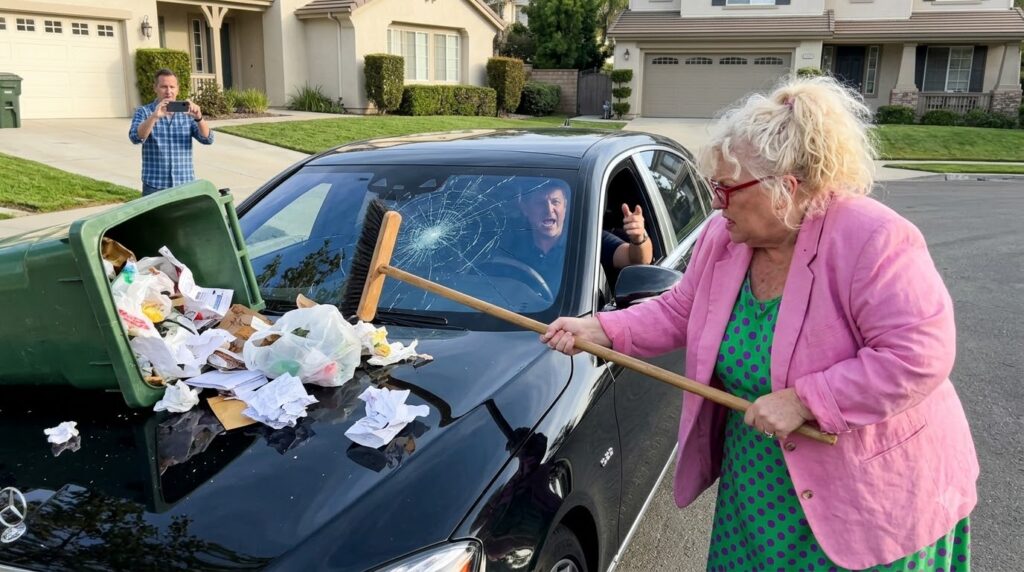
Meanwhile, the damage to the Maybach was becoming more expensive.
The repair facility discovered scratches across the hood and damage to exterior trim beneath the garbage.
The final estimate reached nearly $18,700.
Daniel’s insurance company began processing the claim, subject to his deductible and policy terms.
The insurer also requested Michael’s recording.
Daniel supplied it.
Karen had not contacted him to apologize.
Instead, she sent another letter.
This one accused Michael of illegally recording an HOA officer and threatened legal action if the video continued circulating.
Michael showed the letter to Sarah.
She explained that recording an incident openly occurring in a residential driveway and visible from a public-facing sidewalk raised different issues from secretly recording a confidential conversation.
She advised Michael to preserve the original file and avoid editing or misrepresenting it.
Michael nodded.
Then he said something that surprised Daniel.
“I think she’s getting scared.”
Daniel looked at the threatening letter.
“She doesn’t sound scared.”
Michael smiled faintly.
“That’s how Karen sounds when she is.”