Chapter 9: The Driveway Where It All Began
Six months after the attack, Daniel stood in his driveway on a cool Saturday morning, washing the Maybach.
The California sun had just risen above the rooftops.
Water rolled across the black paint, carrying away soap and dust.
The repaired windshield reflected the oak trees lining the street.
Rebecca stepped outside carrying two mugs of coffee.
She handed one to Daniel.
“You know,” she said, “we could hire someone to do that.”
Daniel smiled.
“I know.”
She watched him rinse the hood.
“Then why are you out here every other Saturday?”
He considered the question.
At first, washing the car had been a way to reassure himself that it was undamaged.
He had examined the windshield repeatedly, looking for imperfections that were no longer there.
Over time, the ritual had become something else.
A quiet hour.
A familiar task.
A reminder that he could enjoy what he had earned without apologizing for it.
“I guess I like taking care of things,” he said.
Rebecca smiled.
“That sounds like you.”
Across the street, Michael emerged from his garage carrying a toolbox.
He waved.
Daniel waved back.
The two men had become close friends during the ordeal.
They now met for breakfast twice a month and occasionally attended HOA meetings together.
Michael still recorded important public meetings when permitted.
But he no longer felt compelled to document every neighborhood disagreement.
The atmosphere had changed.
Residents spoke more openly.
Board members answered questions.
Violation notices included actual rule references.
And the proposed $2,400 special assessment had been withdrawn.
A new security plan was being evaluated through an open budgeting process, with competitive bids and homeowner input.
Not everyone agreed on every decision.
They never would.
But disagreements no longer automatically became personal battles.
Karen still lived in Willow Creek Estates.
Daniel saw her occasionally.
Sometimes she drove past in her silver SUV.
Sometimes he noticed her collecting mail.
She no longer approached his driveway.
He did not seek her out.
The court case had concluded, the financial disputes had been addressed through the appropriate processes, and her HOA leadership had ended.
There was nothing left to gain from another confrontation.
One afternoon, several weeks earlier, Daniel had encountered her at the neighborhood mailboxes.
She stood beside her vehicle holding a stack of envelopes.
For a moment, they looked at each other.
Karen seemed about to speak.
Then she lowered her eyes and walked away.
Daniel had not followed.
He had once imagined that a sincere apology would provide closure.
But he had come to understand that closure did not always arrive through another person’s words.
Sometimes it came from knowing you had acted with restraint, protected your family, and pursued accountability through the proper channels.
He no longer needed Karen to validate what had happened.
The evidence had done that.
Later that morning, Sophie came outside carrying her car keys.
She had recently earned her driver’s license.
Her first car was a used Honda Civic that Daniel had helped her purchase after she saved money from a summer job.
She stopped beside the Maybach.
“Dad, can I ask you something?”
“Of course.”
“Would you still buy this car if you knew everything that was going to happen?”
Daniel looked at the black sedan.
He thought about the broken windshield.
The garbage.
The police.
The threatening letters.
The meetings.
The court hearings.
Then he thought about Michael standing on the sidewalk with his phone.
Evelyn speaking at the clubhouse.
Rebecca holding his hand when the situation felt overwhelming.
And Sophie learning that standing up for yourself did not require becoming cruel.
“Yes,” he said.
Sophie raised an eyebrow.
“Really?”
“Really.”
“Even after all that trouble?”
Daniel leaned against the garage door.
“The car didn’t cause the trouble. Someone made a bad decision.”
He glanced toward the street.
“And if I started giving up things I worked for because someone else didn’t like them, where would that end?”
Sophie considered his words.
Then she smiled.
“Fair point.”
She climbed into her Honda and drove carefully toward the neighborhood entrance.
Daniel watched until she disappeared around the corner.
Rebecca stood beside him.
“She’s growing up.”
“Too fast.”
They laughed quietly.
That afternoon, Daniel received an email from Robert Hayes.
The HOA had completed its updated policy handbook.
The board wanted to thank residents who had contributed to the review.
Attached was a draft of the opening statement.
Daniel read it aloud to Rebecca.
“The purpose of the Willow Creek Homeowners Association is to preserve shared property, support community standards, and serve homeowners through transparent, consistent, and respectful governance.”
Rebecca nodded.
“That’s a good start.”
Daniel agreed.
But he knew a statement was only meaningful if people followed it.
He replied with a short note thanking Robert and encouraging the board to continue making its decisions openly.
Then he closed his laptop.
Outside, the neighborhood was peaceful.
Children rode bicycles along the sidewalks.
A retired couple walked their golden retriever.
Someone was trimming roses.
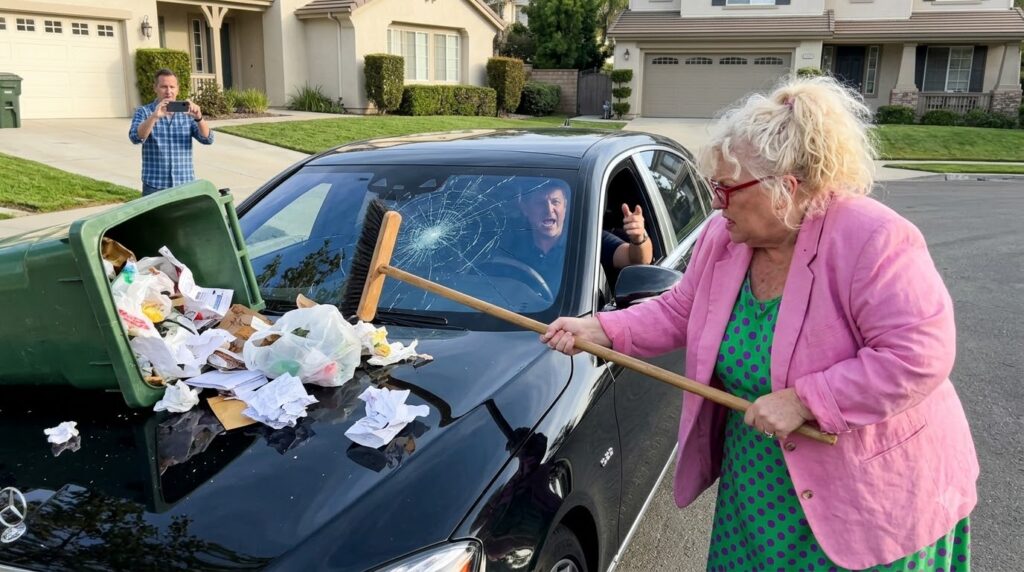
The same driveway where Karen had once dumped garbage onto his car now looked entirely ordinary.
Daniel stepped outside and stood beside the Maybach.
He remembered the sound of the first crack.
He remembered the shock of seeing Karen raise the broom handle again.
And he remembered Michael’s voice announcing that the entire incident had been recorded.
Ten seconds.
That was all it had taken to expose a problem that had been growing for years.
But the real change had required months of patience, evidence, difficult conversations, and neighbors willing to stand together.
Daniel ran his hand lightly across the repaired hood.
The surface was smooth.
The windshield was clear.
His home was still his home.
And the street beyond his driveway belonged to every resident who lived there—not to the loudest person claiming authority over it.
He opened the driver’s door and settled behind the wheel.
The engine started with a quiet hum.
He checked his mirrors, fastened his seat belt, and slowly backed out.
No one blocked his path.
No one shouted.
No one waved a clipboard or threatened a fine.
Daniel drove toward the neighborhood gate beneath the warm California sun.
For the first time in months, it felt like an ordinary drive.
And that, he realized, was exactly what he had been fighting to get back.