
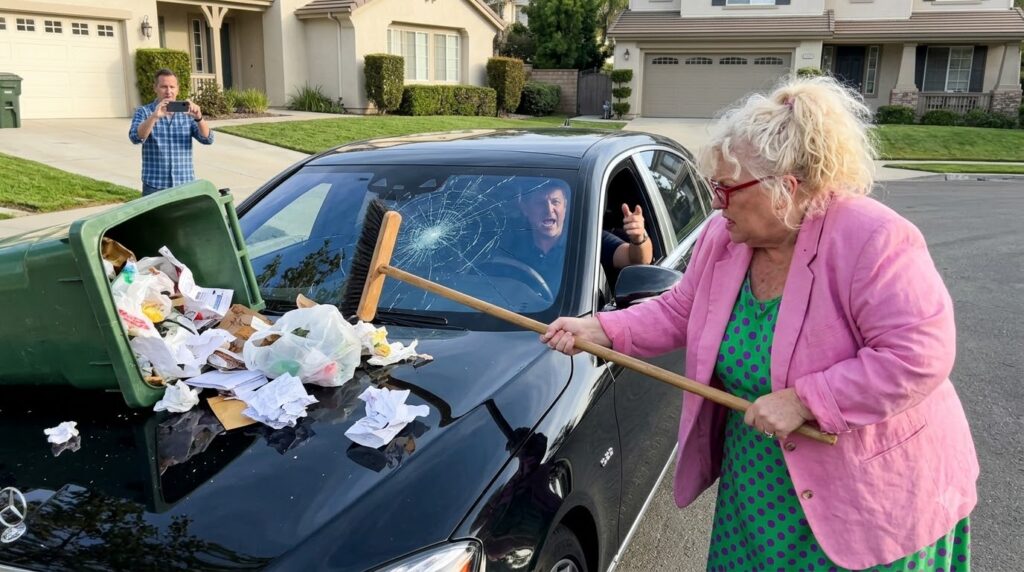
Chapter 7: When the Evidence Reached the Wrong Hands
Karen’s complaint created a new problem for the association.
The board’s attorney advised the directors to preserve all relevant records and avoid public speculation.
Meanwhile, the independent accounting firm began reviewing Evergreen’s contract, invoices, and supporting documentation.
Daniel tried to return to his normal routine.
His company needed him.
Projects were moving forward.
Employees had questions.
Clients expected decisions.
But the dispute followed him everywhere.
He received calls from reporters after Michael’s video began circulating beyond the neighborhood.
One local television station requested an interview.
Daniel declined.
He did not want a public spectacle.
He wanted the damage repaired, the rules followed, and the community protected from further abuse.
Michael, however, believed the video served a public purpose.
He had shared the original recording with investigators and the insurance company. After consulting Sarah about privacy and legal concerns, he also allowed a local reporter to review it.
The reporter contacted Karen for comment.
Karen responded through an attorney.
She claimed that the video lacked context and that Daniel had engaged in provocative conduct before the recording began.
That allegation concerned Daniel.
He knew the video began as Karen stepped into his path.
It did not show the minutes before the incident.
Although he had done nothing threatening, he wanted independent evidence.
Then Rebecca remembered something.
Their home security system included a camera overlooking the driveway.
Daniel had checked the live feed occasionally but had not reviewed the archived footage because Michael’s recording seemed sufficient.
He opened the security application.
The system retained footage for thirty days.
The incident had occurred less than three weeks earlier.
He selected the date.
The camera showed his garage door opening.
The Maybach emerged slowly.
Karen was already waiting near the driveway entrance.
She had positioned the garbage bin beside the curb.
For almost four minutes before Daniel appeared, she paced back and forth.
At one point, she looked toward the street and spoke into her phone.
Then she placed the broom handle beside the bin.
Daniel watched the sequence in silence.
Karen had not simply reacted impulsively to his approaching vehicle.
She had arrived prepared for a confrontation.
The camera had no useful audio of her phone conversation, but the visual evidence was unmistakable.
Daniel immediately forwarded the original footage to Sarah.
She arranged to preserve it in its native format.
The new recording showed the full lead-up to the attack.
And it directly contradicted Karen’s claim that Daniel had surprised or threatened her.
The accounting review produced its preliminary findings the following month.
The independent firm identified several weaknesses in the HOA’s purchasing procedures.
Evergreen had received payments for documented compliance work.
But some invoices lacked adequate descriptions or supporting records.
The reviewers also found that several charges had been approved without the level of documentation required by the association’s internal policies.
The family relationship between Karen and Christopher had not been formally disclosed in the board’s conflict-of-interest records.
The accountants did not conclude that all questionable payments were fraudulent.
Instead, they recommended further examination, recovery of any unsupported charges, and stronger financial controls.
The board referred the findings to outside counsel.
Christopher disputed the report.
He insisted that missing paperwork did not mean services had not been performed.
His attorney submitted additional records.
Some charges were subsequently substantiated.
Others remained unresolved.
Daniel appreciated the distinction.
He did not want the board to replace Karen’s exaggerations with accusations it could not prove.
Fairness had to apply to everyone.
Even Karen.
The property-damage investigation was moving separately.
The sheriff’s department had reviewed both recordings, witness statements, and repair documentation.
A prosecutor’s office evaluated the case for possible criminal charges.
Karen’s attorney argued that she had acted during a heated neighborhood dispute and had not intended the full extent of the damage.
But the footage showed two deliberate strikes with the broom handle.
The prosecutor filed a felony vandalism charge based on the alleged intentional damage and its value.
The charge was an accusation, not a conviction.
Karen was entitled to contest it.
Daniel understood that.
Still, seeing the case formally filed changed something.
For weeks, Karen had described the incident as an HOA enforcement disagreement.
Now the legal system was examining it as alleged criminal conduct.
The difference mattered.
One evening, Daniel found Sophie sitting at the kitchen table, working on a history assignment.
She looked up.
“Dad, do you hate her?”
He considered his answer.
“No.”
Sophie seemed surprised.
“After what she did?”
“I hate what she did. That’s different.”
He sat across from her.
“People should be held responsible for their actions. But that doesn’t mean we have to spend our lives hating them.”
Sophie nodded slowly.
Then she asked another question.
“Do you think she’ll ever admit she was wrong?”
Daniel looked toward the darkened window.
“I don’t know.”
And for the first time, he realized that he no longer needed her to.