Chapter 4: The Meeting Karen Thought She Controlled
The disciplinary hearing was scheduled for Thursday evening at the Willow Creek clubhouse.
Daniel arrived with Rebecca and Sarah Collins.
Michael came separately, carrying his laptop.
The clubhouse was a single-story building overlooking a small artificial lake. Normally, it hosted holiday gatherings, birthday parties, and neighborhood committee meetings.
That evening, every available chair was occupied.
Word of the Maybach incident had spread quickly.
Several residents had seen Michael’s video.
Others had heard conflicting versions from Karen.
According to one rumor, Daniel had nearly run her over.
Another claimed he had deliberately driven toward her while she attempted to enforce a safety regulation.
Karen had encouraged neither rumor publicly, but she had made little effort to correct them.
She sat at the front table with three other board members.
Her outfit was more restrained than usual: a dark purple jacket, black slacks, and a large pearl necklace.
Her platinum-blonde hair was neatly arranged.
She looked determined to restore her authority.
The meeting began with routine business.
Then Karen announced Daniel’s disciplinary hearing.
She described him as a resident who had repeatedly disregarded association safety concerns.
She claimed that on the morning of the incident, he had approached her in his vehicle in an intimidating manner.
Daniel remained seated.
Sarah had advised him not to interrupt.
Karen continued, suggesting that the damage to his vehicle had occurred during an unfortunate confrontation.
She avoided saying she had deliberately struck the windshield.
When she finished, Sarah stood.
She introduced herself as Daniel’s attorney and asked the board to identify the specific rule Daniel had violated.
Karen referred vaguely to community safety standards.
Sarah requested the section number.
Karen shuffled through her papers.
One board member, a retired accountant named Robert Hayes, leaned forward.
“Karen, I don’t remember approving a restriction on luxury sedans.”
Karen glared at him.
“The president has discretion in emergency situations.”
Sarah calmly asked where that authority appeared in the governing documents.
No one answered.
Then she requested permission to present the video.
Karen objected.
She called it an invasion of privacy.
But the other board members agreed to view it.
Michael connected his laptop to the clubhouse projector.
The recording began.
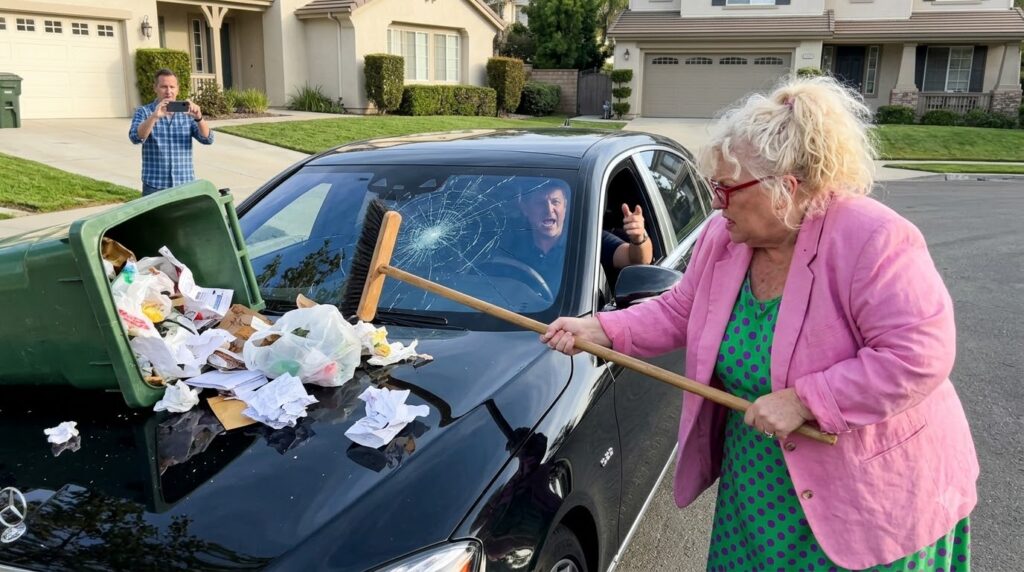
On the large screen, Daniel’s Maybach approached at walking speed.
Karen stepped into its path.
The vehicle stopped.
She overturned the garbage bin.
Then came the first strike.
And the second.
The sound of cracking glass filled the room.
Several residents gasped.
One elderly woman covered her mouth.
The video continued.
Daniel shouted from inside the vehicle.
Karen declared that the HOA prohibited him from driving there.
Michael’s recorded voice announced that he had captured everything.
Then Karen dropped the broom handle.
The screen went dark.
For a moment, the clubhouse was silent.
Robert Hayes slowly removed his glasses.
“Karen,” he said, “you told us he tried to hit you.”
Karen’s face flushed.
“He was threatening me.”
“The car was stopped.”
“He could have moved forward.”
“But it didn’t.”
Another board member, Linda Foster, spoke.
“Did you tell the management company that you smashed his windshield?”
Karen turned toward her.
“I was defending this community.”
A low murmur spread through the room.
Sarah raised one hand.
“The video speaks for itself. My client also has the police report number, photographs, and a repair estimate.”
Karen attempted to regain control.
She declared the discussion out of order and threatened to adjourn the meeting.
But Robert refused.
“This is a board matter now. You cannot simply end it because the evidence is uncomfortable.”
For years, Karen had controlled meetings by speaking louder than everyone else.
This time, the other board members did not retreat.
Linda moved that Karen recuse herself from all decisions involving Daniel’s disciplinary hearing and the vehicle incident.
Robert seconded the motion.
The remaining disinterested directors approved it.
Karen stared at them.
Her authority had been challenged in public.
And she was not prepared to accept it.
After the hearing, residents gathered in small groups outside the clubhouse.
Evelyn Parker, the retired teacher who had been fined over her husband’s wheelchair ramp, approached Daniel.
She was seventy-four, with silver hair and a careful, deliberate manner.
“I watched that video,” she said.
Daniel nodded.
“I’m sorry you had to see it.”
Evelyn shook her head.
“No. I’m glad I did.”
She explained that Karen had once threatened to place a lien on her property over disputed architectural fines.
Evelyn had eventually hired an attorney, and the matter was resolved.
But the experience had left her frightened of opening HOA correspondence.
“I’ve lived in my house for twenty-two years,” she said. “For a while, I felt like I needed permission to walk out my own front door.”
Daniel felt a heaviness in his chest.
He had been angry about his car.
Evelyn had been afraid of losing her home.
Before leaving, she handed him a folded envelope.
Inside was a copy of an old board meeting notice.
Attached was a handwritten note.
Daniel read it under the clubhouse lights.
The note identified Evergreen Community Solutions as a recommended vendor.
At the bottom was a name.
Christopher Whitmore.
Karen’s son.