
Chapter 3: What the Neighbors Had Been Afraid to Say
Michael arrived at Daniel’s house the following evening carrying a battered laptop and a folder of printed documents.
He declined coffee.
Instead, he spread the papers across the dining room table.
“I’ve lived here fourteen years,” he began. “Long enough to remember when this HOA actually worked for the homeowners.”
Michael was a retired telecommunications project manager.
He had served on the association’s landscaping committee years earlier but resigned after repeated disagreements with Karen.
Daniel knew him as a quiet, dependable neighbor who helped elderly residents carry groceries and occasionally repaired broken sprinkler heads without asking for payment.
He was not someone who enjoyed neighborhood drama.
That made his concern more troubling.
Michael opened an annual financial statement.
“Three years ago, our HOA had nearly $640,000 in reserve funds.”
Daniel examined the document.
The reserve account was intended for road resurfacing, gate maintenance, drainage repairs, and other long-term community expenses.
Michael slid another statement across the table.
“Last year, the balance dropped below $280,000.”
Daniel frowned.
“That’s a significant decrease.”
“It is. Some of it was legitimate. The entrance gate needed repairs. But look at these consulting expenses.”
A series of payments appeared under the heading Community Compliance Services.
The amounts varied.
$8,500.
$12,200.
$9,750.
Several more followed.
The total exceeded $90,000 over eighteen months.
Daniel looked up.
“Who provides these services?”
“That’s the question I’ve been asking.”
Michael explained that the HOA had hired a company called Evergreen Community Solutions to perform compliance inspections, prepare enforcement recommendations, and advise the board on security improvements.
Karen had championed the contract.
According to meeting minutes, she argued that the neighborhood needed stronger enforcement to protect property values.
But Michael had never seen an Evergreen employee inspecting the community.
He had requested copies of the company’s reports.
The management company told him the documents were confidential.
He had asked the board to explain the payments.
Karen accused him of harassment.
Eventually, Michael stopped attending meetings.
Not because he lost interest.
Because every attempt to ask questions had become a public confrontation.
“Then you bought that car,” Michael said.
Daniel leaned back.
“What does my car have to do with any of this?”
“Karen started telling people expensive vehicles were attracting outsiders. She claimed we needed additional cameras, security patrols, and a redesigned entrance.”
Daniel remembered the special-assessment warning.
Michael continued.
“She proposed a $2,400 assessment per household.”
Willow Creek Estates contained 118 homes.
Daniel quickly calculated the total.
More than $280,000.
“That’s a lot of money.”
“Especially when nobody has shown us why we need it.”
Daniel studied the financial statements.
He was careful not to jump to conclusions.
Unusual expenses did not automatically prove misconduct.
Perhaps Evergreen performed legitimate work.
Perhaps the board had approved the payments properly.
But the lack of transparency concerned him.
“Do you have evidence that Karen personally benefited?”
Michael shook his head.
“Not yet.”
He closed the laptop.
“But I have something else.”
He opened a folder containing copies of previous HOA violation notices.
The first involved a retired schoolteacher named Evelyn Parker.
She had received a $750 fine for installing a wheelchair ramp for her husband.
The second involved a widower, Thomas Reed, who had been threatened with legal action over a small American flag mounted near his front porch.
The third concerned a young couple who had received repeated parking violations after allowing an elderly parent to stay with them during cancer treatment.
Daniel read each document.
Some disputes had eventually been resolved.
Others had resulted in payments simply because the homeowners lacked the time or resources to fight.
“Why didn’t anyone challenge her?”
Michael gave a tired smile.
“Some did. Most got worn down.”
He explained that Karen often used the threat of attorney fees and collection actions to pressure residents into compliance.
Whether every threat was legally valid seemed almost irrelevant.
The possibility of expensive litigation frightened people.
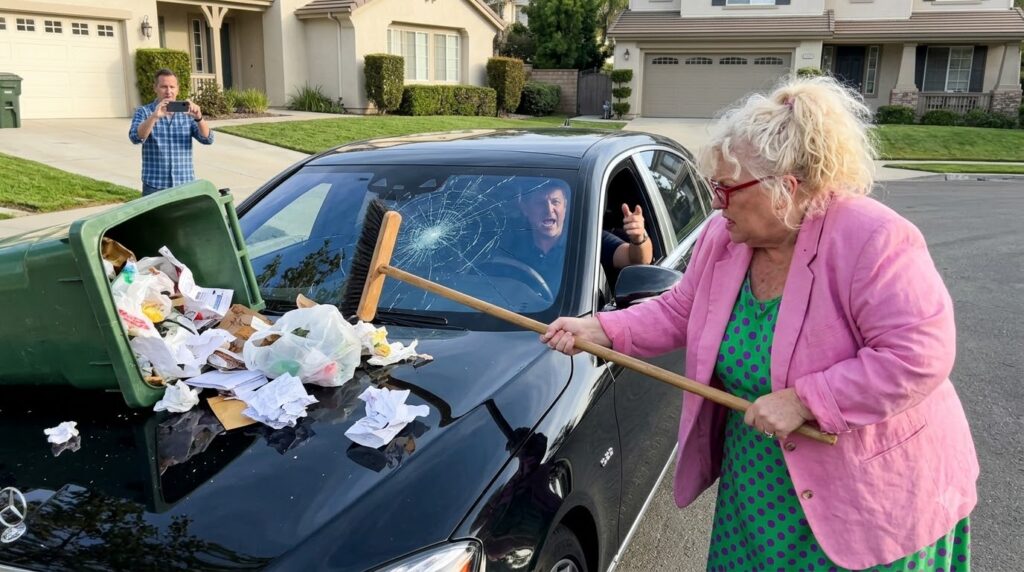
Daniel looked at the photograph of his damaged Maybach on his phone.
He had thought Karen’s behavior was an isolated explosion of anger.
Now he wondered whether it was part of a larger pattern.
The next morning, Daniel contacted an attorney.
Her name was Sarah Collins.
At fifty-eight, she had spent more than twenty-five years handling real estate disputes, homeowner association litigation, and property damage cases.
She listened carefully as Daniel described the incident.
Then she watched Michael’s recording.
Twice.
When it ended, she placed her glasses on the desk.
“The vehicle damage is straightforward,” she said. “The HOA issue is more complicated.”
Daniel explained the nonexistent vehicle restriction and the financial concerns.
Sarah requested copies of the governing documents, violation notices, meeting minutes, and available financial reports.
She also cautioned him against publicly accusing anyone of fraud without evidence.
“Facts are your strongest protection,” she said.
Daniel agreed.
Sarah prepared a formal demand that Karen preserve relevant communications and records concerning the vehicle dispute.
She also sent the HOA management company a request for association records available to members under California law.
Daniel expected resistance.
He did not expect what arrived three days later.
A certified letter from the HOA.
It announced a disciplinary hearing.
The alleged violation was no longer the size of his vehicle.
It was “aggressive conduct toward an association officer.”
Karen had turned the incident around.
She was now claiming Daniel had threatened her.
And the HOA was considering a $5,000 fine.